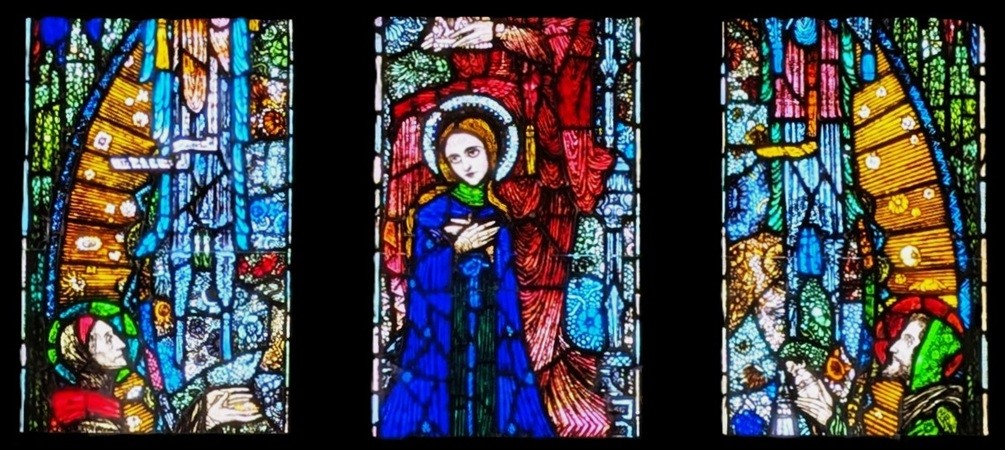
Today on Museum Bites we’re diving into the magical world of Irish illustrator and stained glass artist, Harry Clarke. Dazzling and detailed, the fairytale-like figures in Clarke’s The Coronation of the Blessed Virgin (1923) add a touch of enchantment to this sacred event. Join me for a closer look…
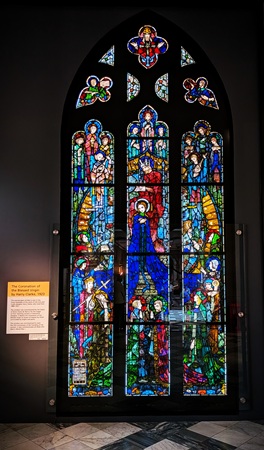
The Coronation of the Blessed Virgin (1923) by Harry Clarke
Kelvingrove Art Gallery & Museum, photo by cjverb (2026)
Commemoration: Originally located in the Sisters of Notre Dame de Namur’s convent chapel in Glasgow, The Coronation of the Blessed Virgin was created to mark the 25th anniversary of the establishment of the convent, and to honor those who died in World War I. Prior to her coronation, Mary, like her son Jesus Christ, is believed to have ascended, body and soul, into heaven. Comprised of 20 separate panels and surrounded by an A-list cast of Christian icons, Clarke’s window captures the moment when Mary is about to be crowned.
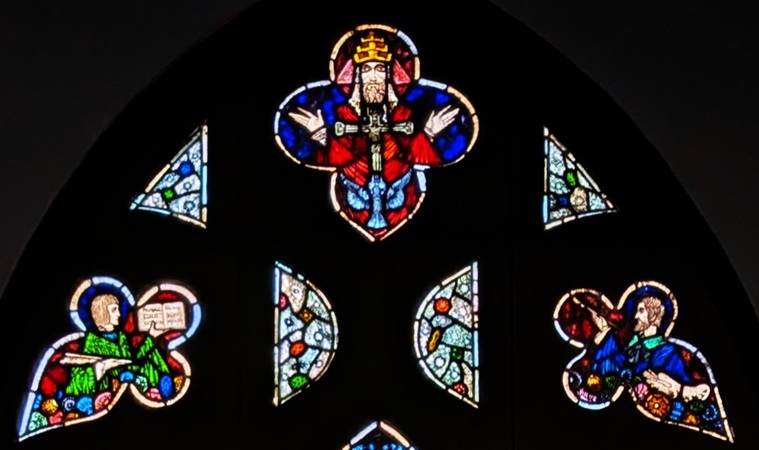
Closeup of The Trinity, The Coronation of the Blessed Virgin (1923)
by Harry Clarke, Kelvingrove Art Gallery & Museum, photo by cjverb (2026)
The Trinity: Beginning at the top, the center quatrefoil (4-lobed window) features the Holy Trinity which is comprised of God the Father in a 3-tiered crown, God the Son represented by the crucifixion, and the Holy Spirit symbolized by a dove. With book and quill in hand, the quatrefoil on the left depicts, St. John the Evangelist, the patron saint of authors. St. Luke, the patron saint of artists, holds a paintbrush and palette, in the quatrefoil on the right.
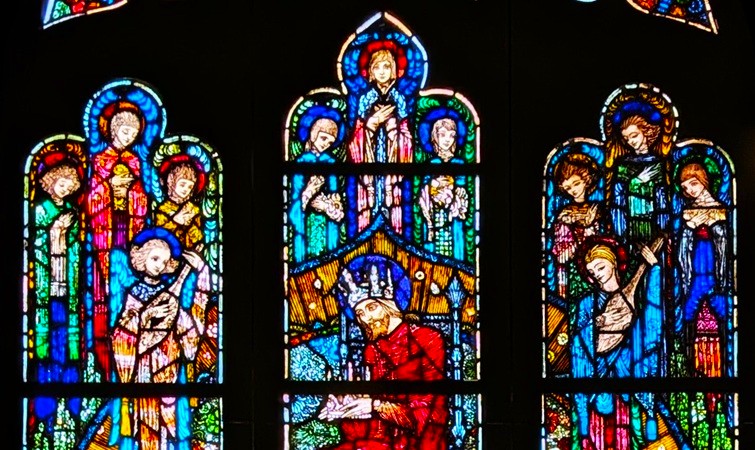
Closeup of Angels and Jesus Christ, The Coronation of the Blessed Virgin (1923)
by Harry Clarke, Kelvingrove Art Gallery & Museum, photo by cjverb (2026)
Jesu Christe: Moving down, the next section is comprised of 3 trefoil-topped windows featuring angels with colorful halos and robes. All but one, gaze upon the proceedings of the coronation below. Beneath the angels, Christ, donning a crown and magnificent red robe, lowers a crown to his mother’s head.
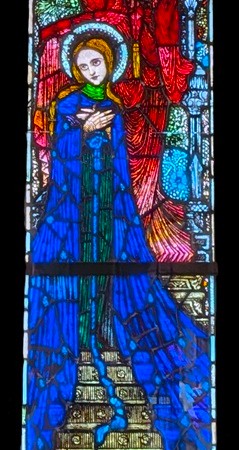
Closeup of Mary, The Coronation of the Blessed Virgin (1923)
by Harry Clarke, Kelvingrove Art Gallery & Museum, photo by cjverb (2026)
Queen Mary: Mary, the colorful star of the window, stands center stage dressed in a vibrant blue robe with a bright green collar. With her head slightly tilted and hands folded across her chest, Mary serenely awaits her crown. Note her long blonde hair and youthful complexion. In comparison to her more mature-looking son, Clarke has cast Mary as young and immaculate. She is The Virgin.
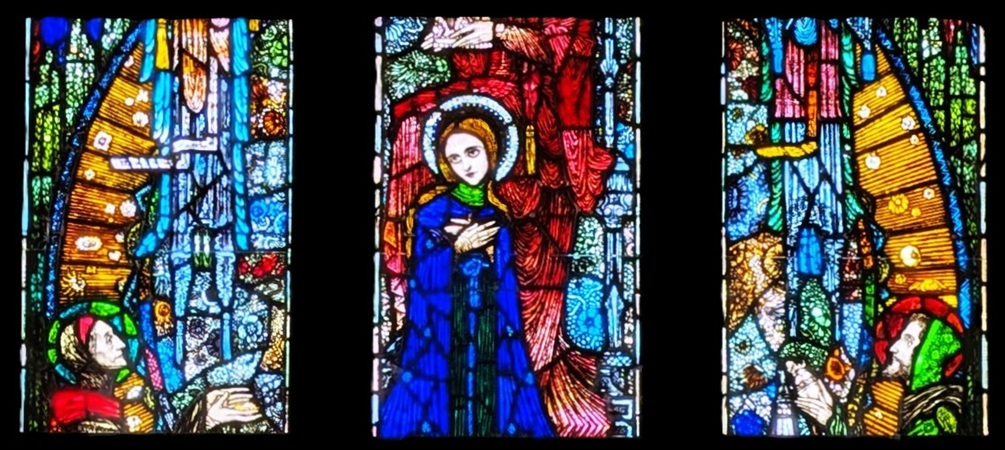
Closeup of St. Anne, Mary & St. Joseph, The Coronation of the Blessed Virgin (1923)
by Harry Clarke, Kelvingrove Art Gallery & Museum, photo by cjverb (2026)
All in the Family: On the left in a red headband, Mary’s mother, St. Anne offers her daughter some jewels while on the right, wearing a bright green hood, Mary’s husband, St. Joseph holds a lantern aloft.
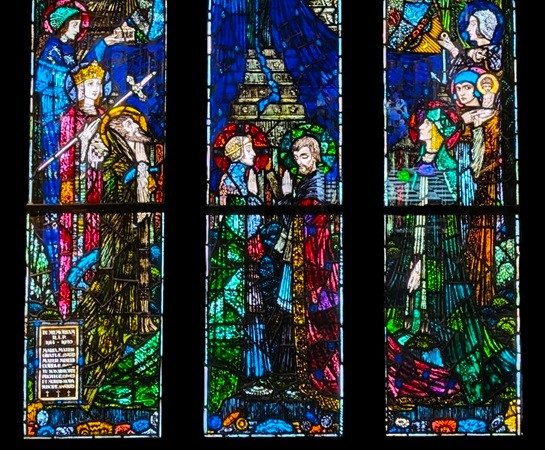
Closeup of Patron Saints, The Coronation of the Blessed Virgin (1923)
by Harry Clarke, Kelvingrove Art Gallery & Museum, photo by cjverb (2026)
Saintly Guests: In the lower sections Mary is encircled by a host of saints. On the left St. Mary Magdalene offers a small container of jewels, St. Catherine of Alexandria cradles a sword, and St. Mungo, the patron saint of Glasgow grasps a fish as he gazes up at Mary. At the foot of the staircase in the center, St. Margaret and St. Andrew of Scotland are deep in prayer. Rounding things out on the right are St. Philomena holding an anchor, St. Christopher with the Christ child on his shoulder gives us a stony stare, and dressed in green with a shamrock is St. Patrick of Ireland*.
*Note, I apologize for the reflection of the checkboard floor pattern obscuring this section of the photo. See Arty Facts below for more info.
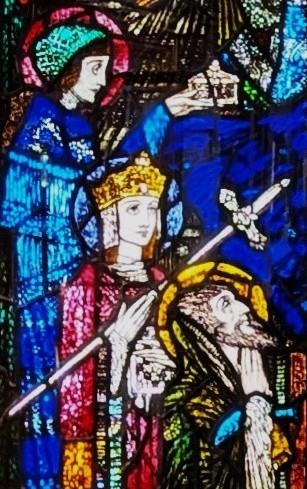
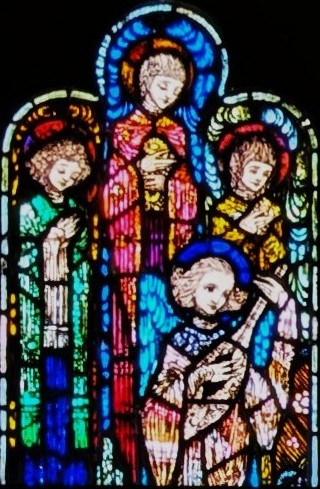
Closeups from The Coronation of the Blessed Virgin (1923) by Harry Clarke
Kelvingrove Art Gallery & Museum, photo by cjverb (2026)
Magic Touch: Churches across the world showcase their religious icons in stained glass, but Clarke takes his craft to another level. He adds an enchanting quality to his images without sacrificing their piety. If you have the opportunity to go to Glasgow I highly recommend you stop by the Kelvingrove Art Gallery and Museum to see this gorgeous window in person.
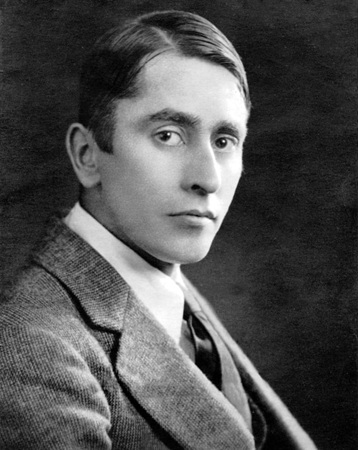
Harry Clarke (c1922) by Lafayette Ltd, Wikimedia Commons
Erin go bragh: Henry “Harry” Patrick Clarke (1889-1931) was born on St. Patrick’s Day in Dublin to Brigid (MacGonigal) and Joshua Clarke. Harry attended Belvedere College, but when he was 14 his mother died and he dropped out. He subsequently went to work for his father’s church decorating business and also enrolled in night classes at Dublin’s Metropolitan School of Art. Harry specialized in stained glass but also became a book illustrator. His lovely, elongated figures and colorful designs were much sought after and his drawings can be found in the works of Edgar Allan Poe, Hans Christian Andersen, and Johann Wolfgang von Goethe, to name a few. In contrast to the pious figures in his stained glass works, Harry’s illustrations were playful, fantastical and sometimes macabre.
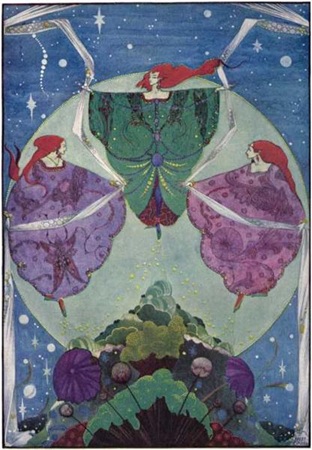
Illustration from Hans Christian Andersen’s
Fairy Tales (c1916) by Harry Clarke, WikiArt
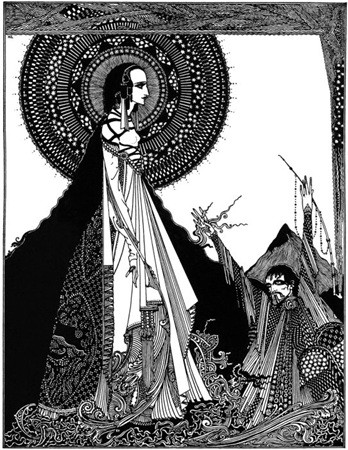
Illustration from Edgar Allan Poe’s Ligeia (1919)
by Harry Clarke, Wikimedia Commons
In the 1920s, Harry’s art was in high demand. In addition, he and his older brother, Walter took over running the family business after their father’s death in 1921. Harry’s increasing workload and the toxic fumes he inhaled from his use of acid-etching to achieve the fine details in his stained glass, began to take a toll on his health. But Harry pressed on. In the late 1920s, after the Irish War of Independence, the Irish Free State government commissioned Harry and his workshop to create a stained glass window for the International Labour Building in Geneva, Switzerland. Members of the government were eager to showcase a new, Irish identity.
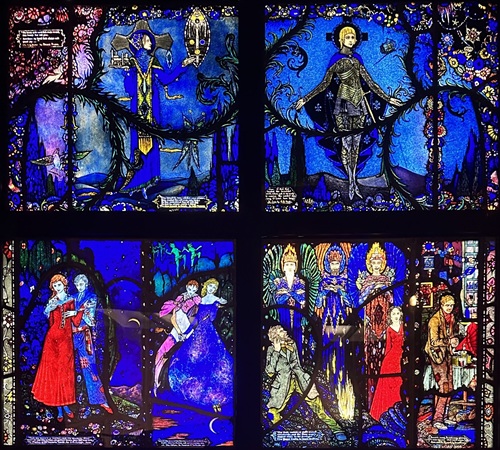
Closeup of The Geneva Window (1930) by Harry Clarke
Wolfsonian-Florida International University Museum, Wikimedia Commons
This window was to feature scenes from the works of 15 of Ireland’s great modern writers but work on this project was complicated by Harry’s failing health. In 1929, he admitted himself to a Swiss sanatorium for 14 months to treat an increasingly severe case of tuberculosis. During his stay he corresponded regularly with his team on the window’s design and creation. He was eventually discharged, but Irish officials were scandalized when they viewed the final product.
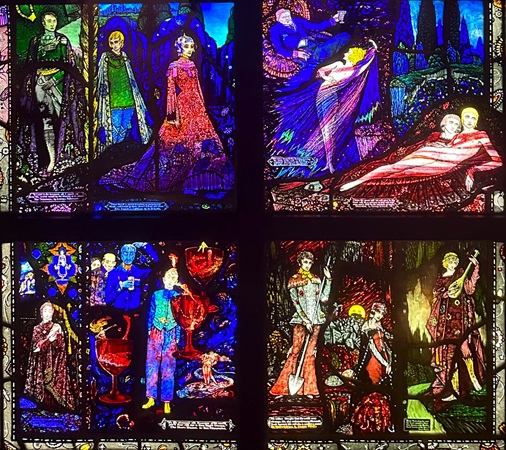
Closeup of The Geneva Window (1930) by Harry Clarke
Wolfsonian-Florida International University Museum, Wikimedia Commons
Some of Harry’s images were deemed “licentious and decadent” and thus, not the Irish identity government officials wanted to promote. Installation was stalled and, in the meantime, Harry’s brother, Walter died of pneumonia. Harry subsequently had a relapse and was re-admitted to the sanatorium. Government officials were still dithering and Harry’s health continued to decline. He eventually died in the sanatorium on January 6, 1931. He was 41 years old.
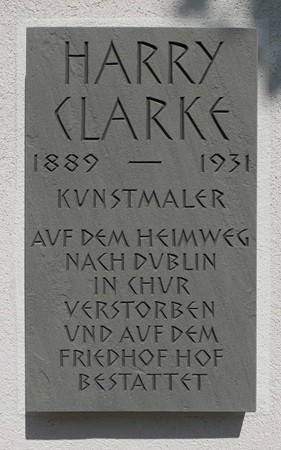
Harry Clarke Commemorative Plaque Hof Cemetery
Chur Switzerland, photo by Roman Deckert, Wikimedia Commons
Over the course of his life, Harry created more than 150 stained glass windows and more than 100 published illustrations. Considered his greatest work, the Geneva Window (1930) was never installed at the International Labour Building. Instead, his wife, Margaret paid the government the original price for the window and kept it in her collection. After her death in 1961, Harry and Margaret’s sons sold it to the Wolfsonian Foundation and today it is on display at the Wolfsonian-Florida International University Museum in Miami. Click on this Geneva Window link for an audio tour.
Arty Facts:
- The Coronation of the Blessed Virgin was moved to the Kelvingrove Museum after the Sisters of Notre Dame de Namur’s convent complex was closed. The buildings have been converted into luxury apartments.
Reflective Fail
Kelvingrove Art Gallery & Museum
photo by cjverb (2026)
*Taking photos in museums can be a tricky business because of all the shiny surfaces and the light reflecting off those surfaces. When I can’t line up a shot to avoid these reflections or edit them out, I try to obtain photos from the public domain. Unfortunately, I was unable to avoid and edit out some of the checkerboard floor pattern from The Coronation window. I was also unable to find a decent photo in the public domain. Click on this Glasgow Museums: Stained Glass Panels of The Coronation of the Blessed Virgin (1923) to view a reflection-free photo (not in the public domain) of this panel.
That wraps up our look at Harry Clarke’s stained glass. I’ll be back next week with more Museum Bites, until then be safe, be kind, and take care🙂
Want more glass? Check out these Museum Bites links:
- Museum Bites: Ancient Iridescence — History of glass and an ancient Roman flagon from the Corning Museum of Glass
- Museum Bites: Cutting Edge –Louis Comfort Tiffany glass from the University of Michigan Museum of Art
- Museum Bites: Shatter Proof – Glass from ancient Pompeii from the Musée des beaux-arts Montréal
- Museum Bites: The Art of Glass Part 1 & Museum Bites: The Art of Glass Part 2 — Glass sculptures from the Flint Institute of Arts
- Museum Bites: Weighty Wonders — Glass paperweights from the Flint Institute of Arts
Sources:
Catholic Online: St. John the Evangelist.
Dublin City Council: #On This Day 1931 Death of Harry Clarke
Encyclopedia Britannica: The Assumption
Encyclopedia Britannica: The Coronation of the Virgin
Glasgow Museums: Stained Glass Panels of The Coronation of the Blessed Virgin (1923)
Glasgow Museums Collections: The Coronation of the Blessed Virgin (1923) by Harry Clarke
National Geographic: The Mysterious Son of a ‘Witch’ Founded Glasgow
National Museum of Ireland: Harry Clarke’s Stained Glass
Sisters of Notre Dame de Namur
Vatican News: St. Luke the Evangelist


Leave a Reply