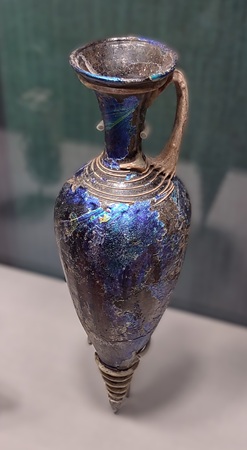
Hello Dear Readers – I’m back from spring break and excited to share some lovely finds from my recent trip to the Corning Museum of Glass (CMOG). Today we’re taking a closer look at a gorgeous glass vessel from the Eastern Roman Empire. Handcrafted in a rich purplish-blue, this colorful container reflects the shifting cultural landscape of the late Roman Empire. Let’s dig into the details, but first a brief history on glass and glassmaking…
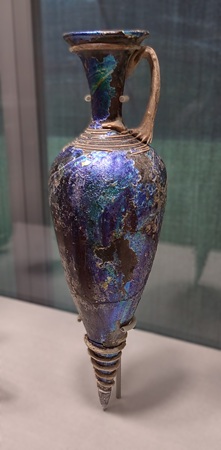
Glass Flagon or Amphora (c300-499 CE) Eastern Roman Empire
Corning Museum of Glass (CMOG), photo by cjverb (2026)
Ancient Craft: The majority of glass is made by melting a mixture of silica (sand), soda ash, and lime. Glassmaking began approximately 4,000 years ago, with the oldest examples of beads, decorative vessels, and figurines made in ancient Mesopotamia and Egypt. This new technology eventually spread, but glass remained a luxury item.
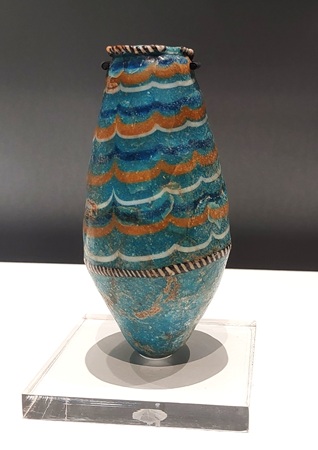
Glass Bottle (c1360-1225 BCE), Egyptian, CMOG, photo by cjverb (2026)
Ancient Ingenuity: During the 1st century BCE, as the Roman Empire expanded, artisans in Jerusalem began experimenting with glassblowing. This new technique was simpler, cheaper, and craftsmen could play with a variety of methods to create glassware. Production went up, the price went down, and design and function flourished. Glass was not only prettier, it also did not impact the smell or taste of the contents stored inside it, unlike ancient containers made of terracotta or bronze. The glass container we’re focusing on today was handcrafted in the Eastern Roman Empire sometime between 300 to 499 CE. Let’s take a closer look…
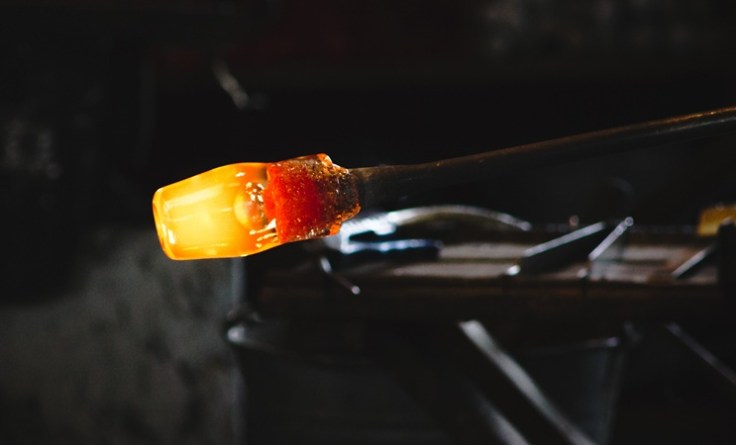
Glassblowing, Wayback Machine Gallery, Wikimedia Commons
Dipping: Standing just over a foot tall, this vessel was created using a dip-mold (aka optic mold) whereby molten glass was partially inflated into a cylindrical mold. It was then removed, further inflated and tooled (shaped) into its current form. An opaque white handle was subsequently attached and heated strands of glass, called trails, were wound around the neck, upper shoulder, and foot (base). Click on this Corning Museum of Glass Dip Molding link for a brief demo.
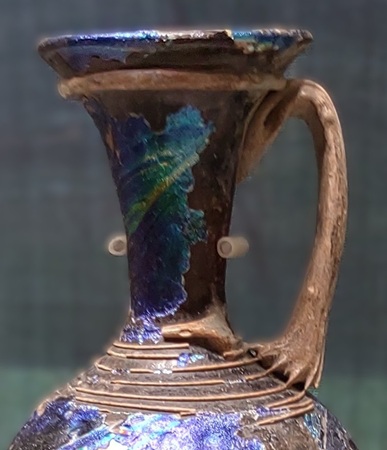
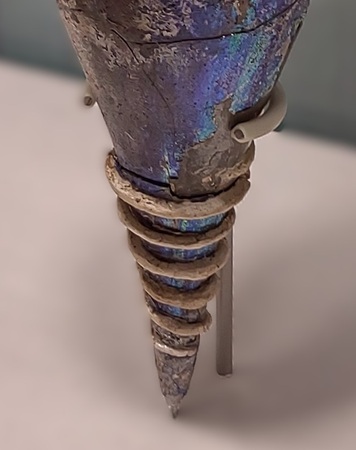
Glass Flagon or Amphora Closeup of Handle & Trails (c300-499 CE) Eastern Roman Empire, CMOG, photo by cjverb (2026)
Coloring & Corroding: The deep purple-blue color was most likely achieved by mixing in a metal oxide such as manganese dioxide or cobalt. The glittery surface is a common feature found on ancient glass. This sparkly coating was not a deliberate design choice by the glassmaker. Instead, it is a type of corrosion called weathering, which is caused by extended exposure to moisture in the ground, such as being buried for centuries in damp earth. Weathering produces an iridescent, sometimes flaky surface on glass which is stunning, but a form of decomposition that cannot be reversed or repaired.
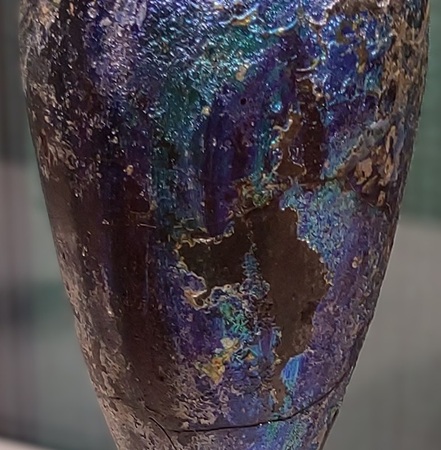
Glass Flagon or Amphora Closeup of Weathering (c300-499 CE)
Eastern Roman Empire, CMOG, photo by cjverb (2026)
Flagon vs Amphora: According to the CMOG website, this vessel is either a flagon or an amphora. A flagon is a large pitcher, that has a lid, spout, and typically one handle. Flagons are used to store and serve liquids like wine or oil.
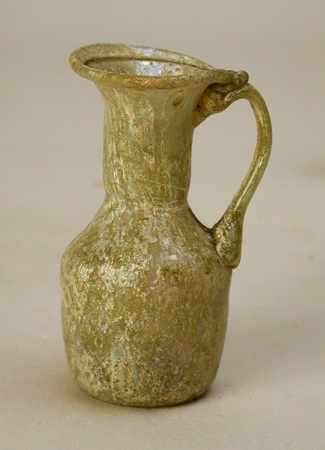
Glass Flagon (c4th century CE) Roman, Detroit Institute of Arts
Amphorae come in several types, but they are defined by their two handles and a neck that is narrower than its body. Their primary purpose was for storing food such as olives, olive oil, grains, and wine. Plain terracotta amphorae with a pointed foot were the Amazon boxes of the ancient world, because they were used as shipping containers. Ancient artisans also created amphorae that were highly decorative works of art.
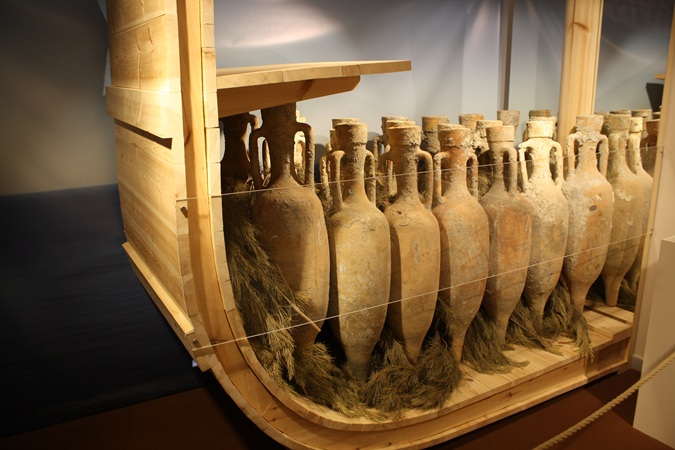
Amphorae Packed for Transport (reconstruction), photo by Mark Cartwright, World History Encyclopedia
At first glance, our vessel looks like an amphora, but with only one handle and no flagon-like spout it is not easily categorized. Perhaps it is a hybrid, a decorative “flamphora” (just made that up!) that stores wine or oil like an amphora, but serves it like a flagon.
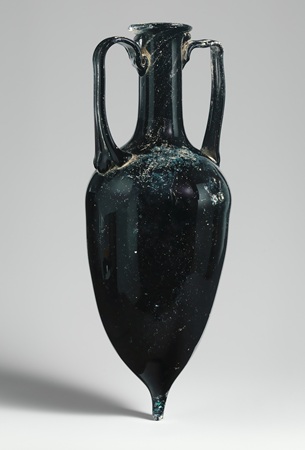
Left: Glass Flagon (c4th century CE) Roman, Detroit Institute of Arts
Center: “Flamphora” (c300-499 CE) Eastern Roman Empire, CMOG, photo by cjverb (2026)
Right: Glass Amphora (early 1st century CE) Roman, Metropolitan Museum of Art
Sign of the Times? When our flamphora was created, the Roman Empire was vast, diverse, split between east and west, and undergoing significant changes. The eastern portion of the empire was on the rise, and the western empire was waning. Constantine I (c280-337 CE) was establishing Constantinople (modern-day Istanbul), a new capital city in the eastern empire, and less than a century later, Rome and the western empire crumbled after repeated attacks by Germanic tribes. The times they were a-changin and maybe an ancient glassmaker was inspired to make some changes too. Despite its cracks and corrosion, this ancient vessel is still a stunning work of art. If you’d like see more ancient Roman glass, click on Museum Bites: Shatter Proof link.
Arty Facts
- Glass is made in nature when sand or rocks high in silica are heated to a high level (i.e. lightning strike, volcanic eruption, meteor strike) and then cooled quickly. Click on this CMOG Glass in Nature link to learn more.
- Ancient glass unearthed in arid climates like Egypt, do not suffer from weathering and therefore do not have an iridescent sheen.
- The Eastern Roman Empire (aka Byzantine Empire) survived for almost a thousand years after the fall of Rome and the Western Roman Empire.
- The Byzantines referred to themselves as Roman. It was only after their defeat by the Ottoman Turks in 1453, that Europeans began to refer to them as Byzantine. Click on this Encyclopedia Britannica: Byzantine Empire link if you’d like to dig deeper.
That wraps up our look at ancient glass. I’ll be back next week with more Museum Bites, until then be safe, be kind, and take care😊
Sources:
Corning Museum of Glass: Amphora (c300-499 CE), Eastern Roman Empire
Corning Museum of Glass Blog: Glass Corrosion-Weathering
Corning Museum of Glass Dip Molding
Corning Museum of Glass: Glass in Nature
Corning Museum of Glass: Glass of the Romans
Encyclopedia Britannica: Amphora
Encyclopedia Britannica: Byzantine Empire
Metropolitan Museum of Art: Roman Glass
Roman Art and Archaeology (2019) by Mark Fullerton
University of Milwaukee: Glass from the Past an Ancient Roman Amphoriskos in the UWM Collection

