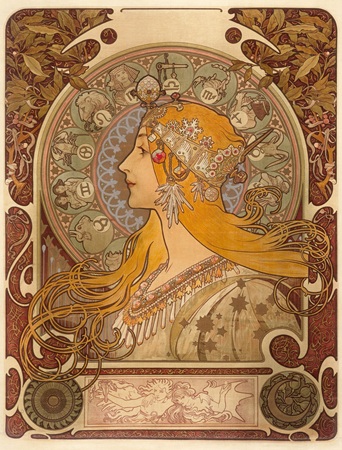
Happy May Day! Today on Museum Bites, we’re kicking off the merry month of May with Zodiac (1896) by Alphonse Mucha. This delightful print began as a calendar, but its fresh, whimsical style helped define a new artistic movement. It is also an example of Mucha’s desire to make beautiful art available to not only the wealthy but the working class. Join me for a closer look at this fascinating print…
Zodiac (1896) by Alphonse Mucha
Los Angeles County Museum of Art
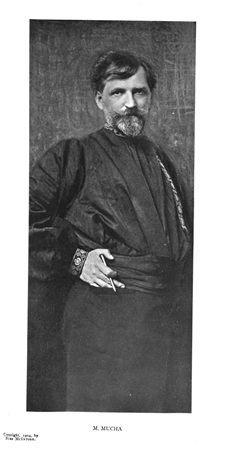
I was happy to be involved in an art for the people and not for private drawing rooms. It was inexpensive, accessible to the general public, and it found a home in poor families as well as in more affluent circles. – Alphonse Mucha
Alphonse Mucha (1904)
The Burr McIntosh Monthly
Wikimedia
Calendar Girl: Zodiac was the first artwork Mucha created for his new boss, Parisian printer F. Champenois. Designed as an in-house calendar, Zodiac caught the eye of La Plume editor Léon Deschamps, who subsequently published it in his magazine. Let’s zoom in and take a closer look at the details…
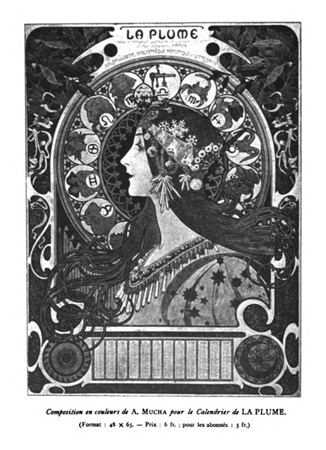
Zodiac Calendar (1896) by A. Mucha
La Plume, HathiTrust Digital Library
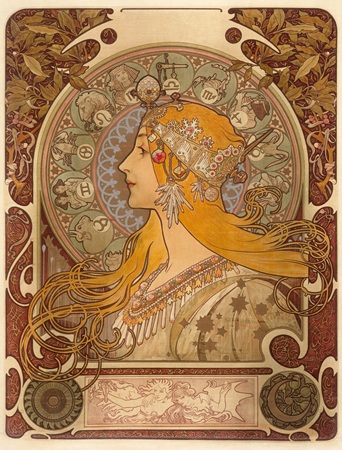
Celestial: Cast against a leafy border is a young woman in profile. A halo comprised of the 12 signs of the zodiac surrounds her head. She wears an elaborate headdress with a faceted orb sprouting from the front. An array of bangles that include crystals, jewels, and snowflakes decorates the side of her headdress.
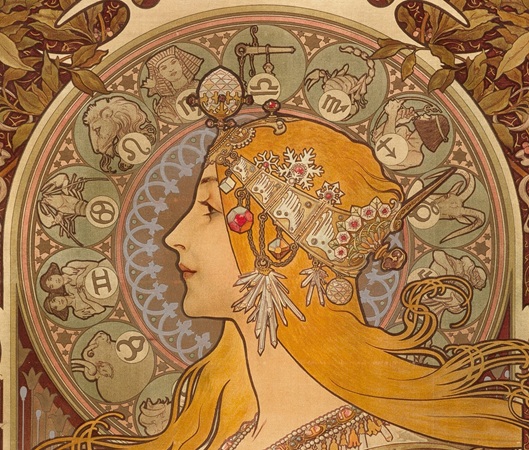
Closeup of Zodiac (1896) by A. Mucha
Los Angeles County Museum of Art
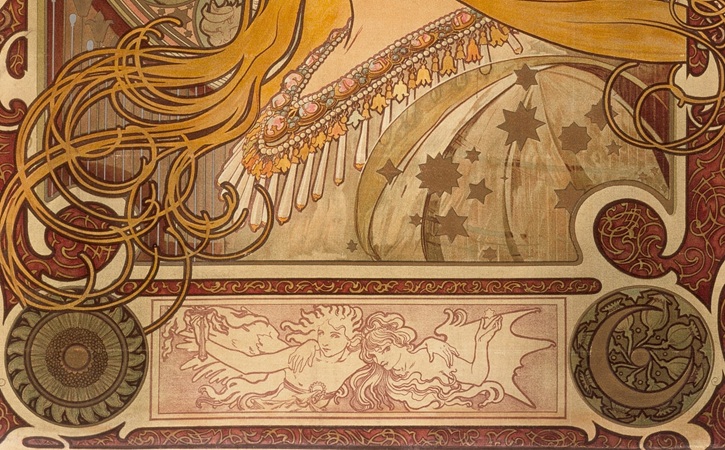
Her tawny, unbound hair swirls and curls in a Medusa-like fashion and overlaps onto the leafy border. The neckline of her dress is bedazzled with more trinkets, and her puffed sleeve is decorated with a variety of gold stars.
Closeup of Zodiac (1896) by A. Mucha
Los Angeles County Museum of Art
There are nine variations of Zodiac. In this version, the calendar beneath the woman’s portrait is replaced with an image of two women with their arms slung over each other’s shoulders. This is possibly a representation of the new year (left), ushering out the old year (right). These women are flanked by a sun with a sunflower behind it on the left, and a moon with poppies in the background on the right.
Zodiac (1896) by A. Mucha
Los Angeles County Museum of Art
Finally, note Zodiac’s pale, soothing palette, strong contour lines—especially around her face, headdress, and hair—and all the swoops and swirls. With its touch of blooming greenery, Mucha’s creation is quintessential Art Nouveau.
C’est Fantaisiste et Fonctionnel: Art Nouveau (c1890-1910) was a short-lived movement that emerged in Europe and the United States at the turn of the 20th century. It rejected the traditional belief that decorative and craft arts were inferior to painting and sculpture. Everyday objects like calendars, table lamps, furniture, and metro station entrances were opportunities to create functional art that was not only beautiful, but high-quality. A Tiffany lamp, for example, lights up a room, but it is also a stunning work of art.
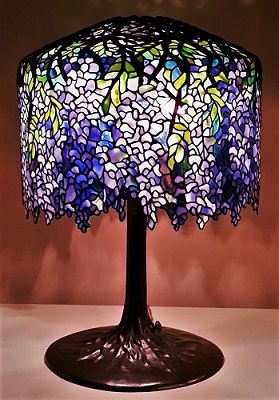
Tiffany Lamp (c1902) by Clara Driscoll
Virginia Museum of Fine Arts, Photo by Fopseh, Wikimedia
Art Nouveau’s style is characterized by curves and swerves and swooping tendrils that typically blossomed into flowers, greenery, or insects. It is fanciful, feminine, and was an aesthetically pleasing counterpoint to the onslaught of the turn-of-the-century industrialized world. Hector Guimard’s Paris Metro station entrances are a good example.
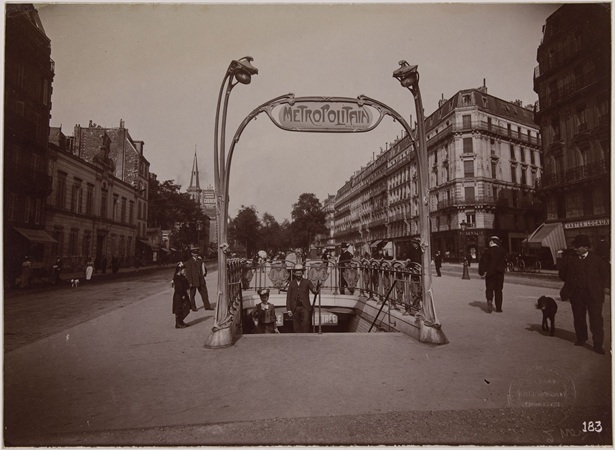
Paris Metro Station (1903) designed by Hector Guimard
photo by Charles Maindron, Wikimedia
In addition to Mucha and Guimard, artists who dabbled in the Art Nouveau style include Clara Driscoll (1861-1944), Gustav Klimt (1862-1918), and Victor Horta (1861-1947), to name a few.
Multitalented Mucha:
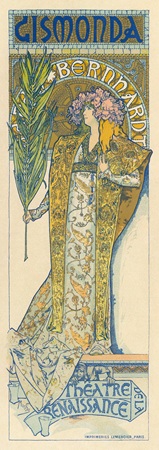
Alphonse Mucha (1860-1939) was born into a working-class family in Ivančice, Moravia (modern-day Czech Republic). He initially painted theatrical sets, but while studying art in Paris, he moonlighted as a magazine and book illustrator. Mucha’s career took off in 1894, when he was commissioned to create a poster advertising actress Sarah Bernhardt’s (1844-1923) play Gismonda. The softer palette and dignified design were in stark contrast to the brashness of previous posters. Collectors bribed theater staff to obtain copies, and some went so far as to use razors to cut them directly off the walls.
Gismonda Poster (1894) by A. Mucha
restored by Adam Cuerden
Gallica Digital Library, Wikimedia
Bernhardt was thrilled and commissioned Mucha to create additional play posters as well as design theatrical sets and costumes. Mucha went on to design jewelry, furniture, and tableware. He also taught art and authored several books.
War & Independence: By the start of World War I, Art Nouveau began to wane, but Mucha was not deterred. In the latter half of his career, he turned to more spiritual and political art. As a result of the war, the Austro-Hungarian Empire collapsed, and Mucha’s beloved homeland gained independence and became part of the newly formed Czechoslovakia. In 1918, Mucha was commissioned to create images for the first Czech postage stamps and banknotes.
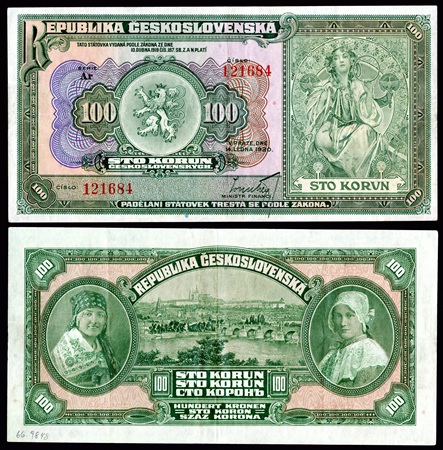
Czechoslovakian 100 Korun (1920) photo courtesy of National Numismatic Collection
National Museum of American History at the Smithsonian Institution, Wikimedia
Passion Project: In 1926, Mucha completed his passion project, The Slav Epic (1911-1926), a series of 20 massive paintings (approx. 20 ft x 26 ft) depicting the history of the Slavic people. He donated the series to the city of Prague.
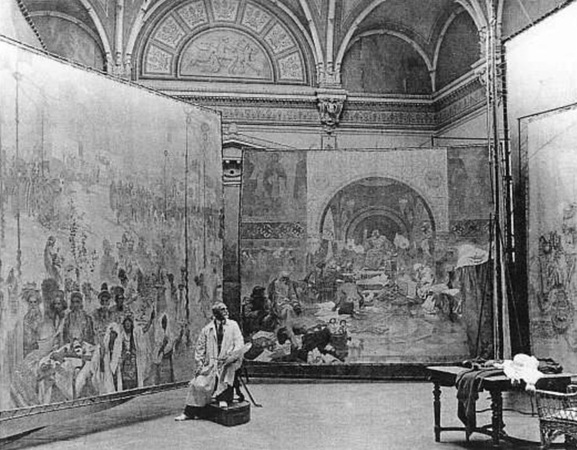
Alphonse Mucha working on The Slav Epic (1920), Wikimedia
In the 1930s, Europe was again on the verge of war, and Czechoslovakia was invaded by the Nazis in 1939. Considered a reactionary, the Gestapo interrogated Mucha, who was in poor health. He was eventually released but died of pneumonia shortly after. Mucha was just ten days shy of his 79th birthday.
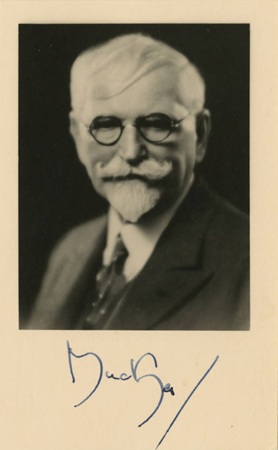
Alphonse Mucha (before 1939)
Studio of JN Langhans, Wikimedia
Arty Facts
- Mucha shared his Paris studio with the artist Paul Gauguin. It was a festive, raucous place to work and gather with arty friends, as noted by the famous photo Mucha took of Gaugin playing the harmonium without pants.
- Mucha designed a coiling, gold snake bracelet with an attached finger ring for Sarah Bernhardt. It was crafted in true Art Nouveau style, curvy, gorgeous, and functional because it made accommodations for Bernhardt’s arthritic wrist. Click on this Wikimedia: Sara Bernhardt Snake Bracelet link for a look-see.
- The Art Nouveau style has different names and variations in different countries. It is referred to as Jugendstil in Germany, Modernismo in Spain, Sezessionstil in Austria, and Stile in Italy.
That wraps up our look at Alphonse Mucha and Zodiac. Want to take a deeper dive? Click on TheArtStory: Alphonse Mucha link to learn more about his life and art. If you’d like to view more gorgeous Art Nouveau art, click on TheArtStory: Art Nouveau link. And finally, if you’d like to learn more about Moravian and Czechoslovakian history, click on this Encyclopedia Britannica: Czechoslovak History link.
I’ll be back next week with more Museum Bites, until then be safe, be kind, and take care😊
Sources:
Encyclopedia Britannica: Art Nouveau
Encyclopedia Britannica: Czechoslovak History
Encyclopedia Britannica: Moravia
Le Calendrier de La Plume (Jan-Jun, 1897) by Alphonse Mucha, HathiTrust Digital Library


