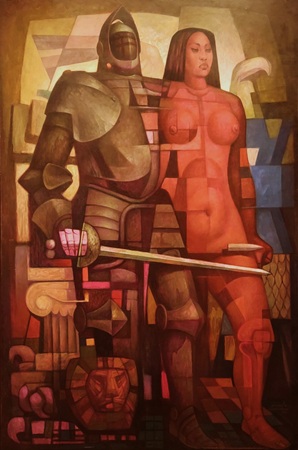
Today on Museum Bites we’re taking a closer look at La Malinche (mah-LEEN-cheh), the mother of modern Mexico. A controversial figure with a complicated past, artists and historians have grappled with her portrayal. Is she the mother of a new nation? A traitor to her people? Or a survivor of the violent world in which she lived? Mexican painter, Jorge González Camarena’s La Pareja (1964) is one interpretation. Join me as we take a tour of this powerful portrait, but first a little background…
La Pareja (1964) by Jorge González Camarena
Albuquerque Museum, photo by cjverb (2022)
Enslaved: Malinche (c1500-1529) was born in the modern-day state of Veracruz, Mexico at a time when the Aztec Empire was flourishing. Although the Aztecs did not control the territory where she lived, Malinche and her people spoke Nahuatl, the Aztec language. When Malinche was a child, she was sold into Maya slavery and while in captivity she learned the Maya language.
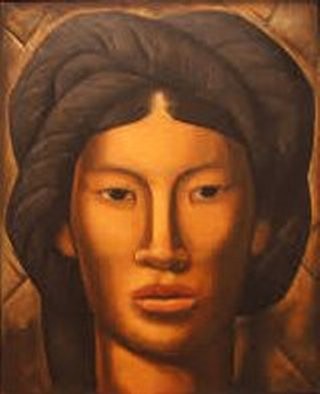
La Malinche (Young Girl of Yalala, Oaxaca; 1940)
by Alfredo Ramos Martínez, Phoenix Art Museum, Wikimedia
In her late teens, she and 19 other enslaved women were given to Spanish conquistador, Hernán Cortés (1485-1547) and his men as a peace offering. Malinche subsequently learned Spanish and when Cortés discovered her gift for languages, he made her his interpreter.
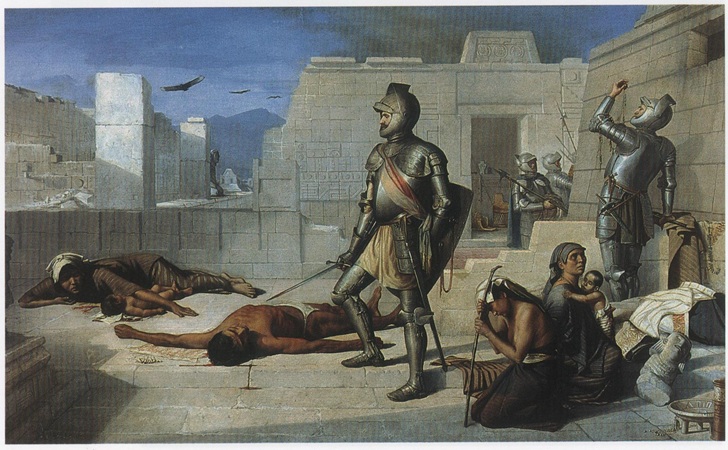
The Massacre of Cholula (1877) by Félix Parra, Université Paris-Sorbonne, Wikimedia
Spanish Conquest: Malinche played a vital role in Cortés’ quest for gold by helping him recruit Indigenous allies to fight the Aztecs. In one case, she thwarted a plot by the Cholula to ambush the Spanish. Malinche most famously served as interpreter at the historic meeting and subsequent interactions between Cortés and Moctezuma II (c1466-1520), emperor of the Aztec Empire.
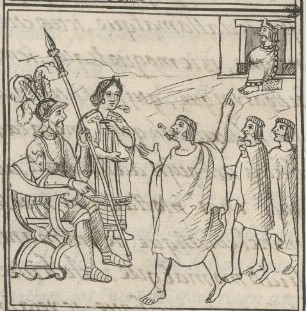
Hernan Cortés & Malinche listen to complaints about
Moteuczoma’s harsh rule over Teocalhueyacan (c1577-1579)
Florentine Codex, Book 12, Folio 47v, Tlahcuiloh artist-scribe
After the murder of Moctezuma, the Spanish and allied Indigenous groups laid siege to the Aztec’s capital city, Tenochtitlán. Ravaged by smallpox, the city eventually fell in the summer of 1521. Cortés declared the land for Spain, and with a heavy hand, oversaw the rebuilding of the city (modern-day Mexico City) with a decisive Spanish stamp.
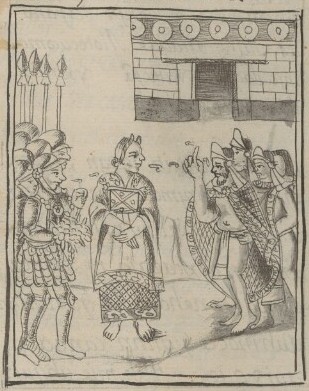
Malinche interprets for Hernan Cortés and Moctezuma (c1577-1579)
Florentine Codex, Book 12, Folio 26r, Tlahcuiloh Artist-Scribe
Doña Marina: The following year, Malinche gave birth to Martín, her and Cortés’ son. Martín was hailed as the first mestizo, (mixed Indigenous and Spanish heritage), a symbolic blending of the two cultures in the new colonial world order. In 1524, Cortés arranged for Malinche to marry Juan Jaramillo, one of his captains. Two years later, the couple had a daughter, María. Malinche’s marriage elevated her to the status of a free, noblewoman and afforded her and her children rights and privileges within the Spanish colonies as well as Spain. Malinche died in 1529, possibly of smallpox. The location of her burial place is unknown.
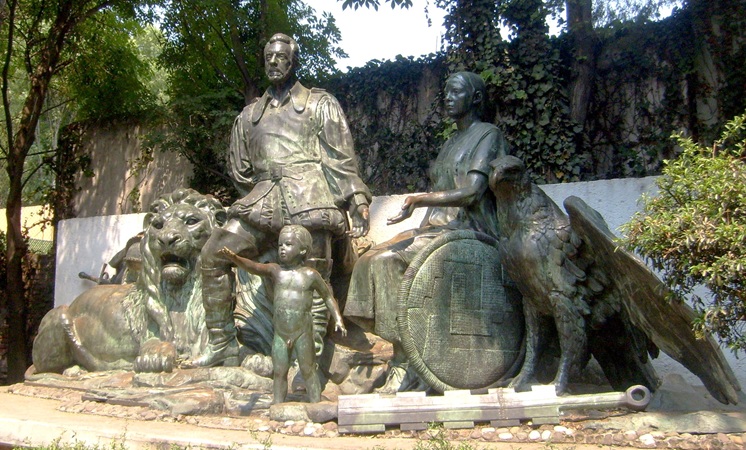
Monumento al Mestizaje (1982) featuring Hernan Cortés, Malinche, and Martín Cortés
by Julián Martínez y M. Maldonado, photo by Javier Delgado Rosas, Wikimedia
Una Fusión: La Pareja (1964) by Jorge González Camarena is an oil on wood portrait of Malinche and Hernan Cortés. Striding forward to the future, La Pareja (the couple) symbolizes the blending of Indigenous and Spanish culture. Note how their bodies are melded together from shoulder to hip. They are flanked by icons of their heritage. On the right, an eagle and feathers represent the Indigenous cultures. On the left, an ionic column and lion represent European culture.
La Pareja (1964) by Jorge González Camarena
Albuquerque Museum, photo by cjverb (2022)
Cortés is dressed in a cold, steel-gray armor. He is faceless, alien, and menacing. In sharp contrast, Malinche is portrayed in warm reds and browns. She is naked and her hair is unbound. Where Cortés is covered and protected, she is exposed and vulnerable. Her posture is regal, her expression somber, but her fist is clenched.
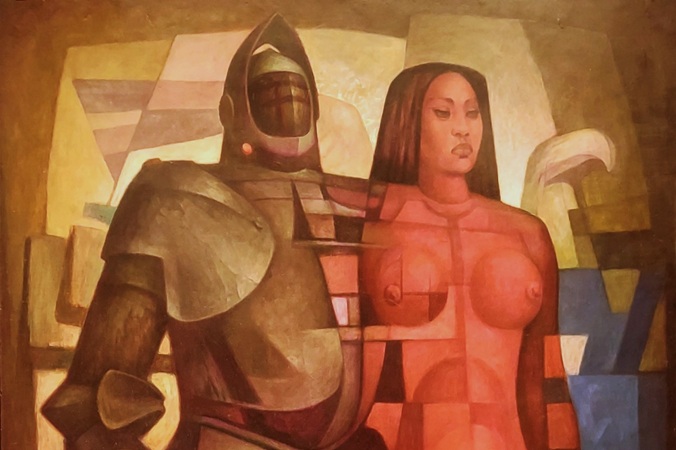
Closeup of La Pareja (1964) by Jorge González Camarena
Albuquerque Museum, photo by cjverb (2022)
Cortés grasps a sword in his sickly, pink fingers, and rests the blade across Malinche’s thigh. Another blade, hiltless, floats above her upper thigh. Is Cortés protecting her or keeping her in check? Perhaps this is a metaphor for Spain’s treatment of the Indigenous people.
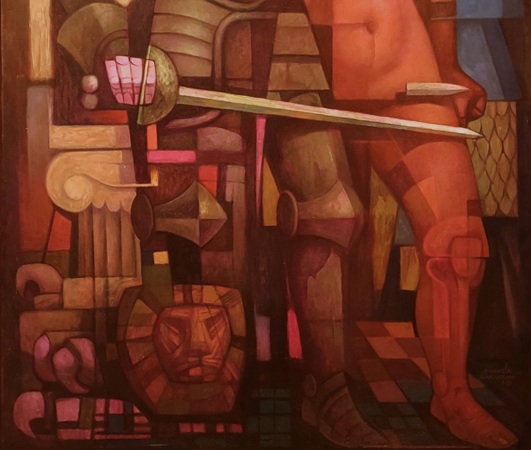
Closeup of La Pareja (1964) by Jorge González Camarena
Albuquerque Museum, photo by cjverb (2022)
In La Pareja, González Camarena highlights the dramatic differences between the two cultures, but the couple, these metaphorical parents of a new civilization, are bound together and marching in step. Cortés’ blade and armor are blatant symbols of force (Spain’s conquest). In contrast, Malinche’s determined expression and clenched fist suggest her quiet resilience.
El Patriota: Painter and sculptor, Jorge González Camarena (1908-1980) was born in Guadalajara, Mexico, and studied art at the Academy of San Carlos in Mexico City. He is best known for his paintings and murals which blend Indigenous mythology and nationalist themes to illustrate Mexican history and promote a Mexican identity that embraces its Indigenous and European heritage.
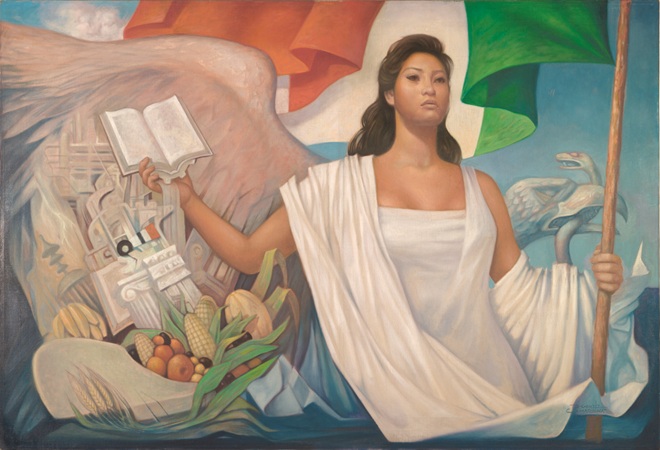
La Patria (1962) by Jorge González Camarena, Wikimedia
Unlike his contemporary and fellow painter, Diego Rivera (1886-1957), González Camarena’s art was not politically provocative. His painting La Patria (1962) was featured on the Ministry of Public Education textbooks from the 1960s and 1970s. González Camarena died in Mexico City at the age of 72.
El legado de La Malinche: Despite being multilingual, we never hear Malinche’s story from her point of view. Instead, what we do know about her has been recorded through the eyes of observers, primarily European. What is evident is Malinche is a survivor and like González Camarena’s painting, life and people are not black and white.
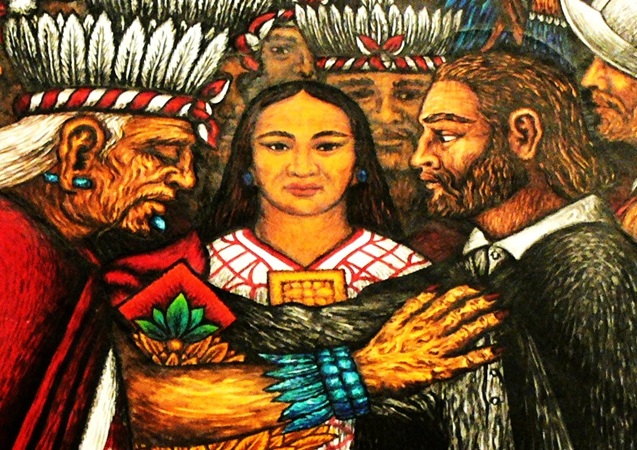
Closeup of La Malinche (1960s-1994) mural on Palacio de Gobierno Tlaxcala
by Desiderio Hernandez Xochitiotzin, photo by Wolfgang Sauber, Wikimedia
Arty Facts
- The Aztecs called themselves Mexica (mah-SHEE-kah). Aztec comes from Aztlan, the Nahau word for the Mexica’s mythical native land. Click on this Khan Academy: Introduction to the Aztecs (Mexica) link to learn more.
- Cortés was not authorized to wage war with the Aztecs or other Indigenous communities.
- The same model who posed for La Patria also posed for La Malinche.
That concludes our look at Malinche. If you’d like to take a deeper dive, click on the following links:
Albuquerque Museum: Traitor, Survivor, Icon: The Legacy of La Malinche
The Rest is History: The Fall of the Aztecs
WikiArt: Jorge González Camarena
I’ll be back next week with more Museum Bites, in the meantime, be safe, be kind, and take care😎
Sources:
Albuquerque Museum: Traitor, Survivor, Icon: The Legacy of La Malinche
American Historical Association: Representations of Malinche
Khan Academy: Introduction to the Aztecs (Mexica)
Los Angeles Times: Mexico Reassesses Malinche from Traitor to Heroine
National Endowment for the Humanities: La Malinche, Hernán Cortés’s Translator and So Much More
Occult Mexican Art: Jorge González Camarena
PBS American Historia: The Complicated Story of La Malinche
San Antonio Museum of Art: Traitor, Survivor, Icon: The Legacy of La Malinche
The New York Historical Society: Malintzin
The Rest is History: The Fall of the Aztecs
Universidad de Concepción: Casa Del Arte José Clemente Orozco

