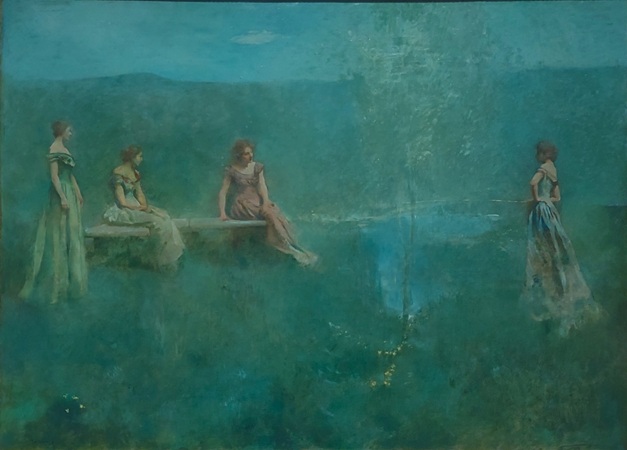
Today on Museum Bites we’re celebrating Earth Day with a look at La Pêche (Fishing) by Thomas Wilmer Dewing. Awash in deep greens and blues, Dewing’s turn-of-the-century painting portrays a lush, dreamy scene, but these elegant ladies are far from casting a rod and reel. Let’s step inside and dig into the deeper meaning behind this lovely work of art. First, the details…
La Pêche (1901-1904) by Thomas Wilmer Dewing
Metropolitan Museum of Art, photo by cjverb (2025)
Communing with Nature: La Pêche features four women, who are, according to the Metropolitan Museum of Art, “communing with nature”. Framed by dense green foliage in the foreground, shadowy hills and a light blue sky with a lone wispy cloud serve as a backdrop.
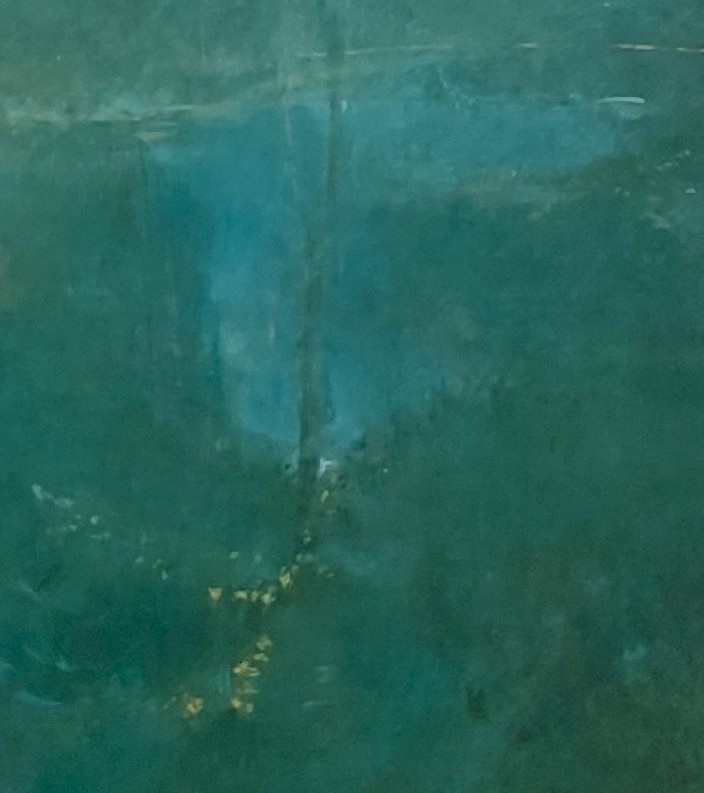
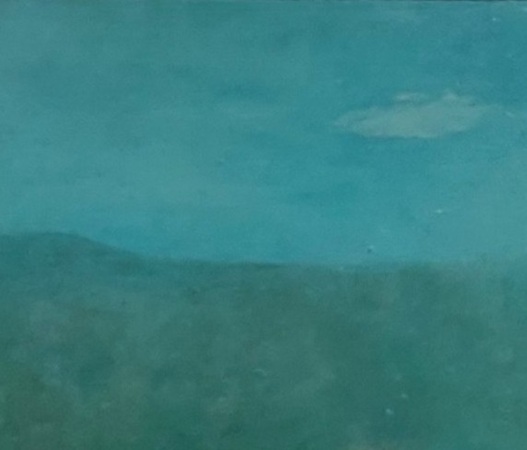
Closeup of foreground (left) and background (right) of La Pêche (1901-1904)
by TW Dewing, The Met, photo by cjverb (2025)
On the right, a woman stands in profile. She wears a full-length gown and with hands on hips, she faces a trio of similarly dressed women. They are separated by a slender, nondescript tree and pond. Despite the distance between them, this woman is the focus of the trio’s attention.
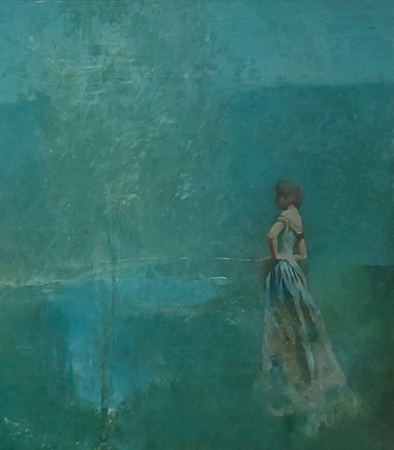
Closeup of La Pêche (1901-1904) by TW Dewing
The Met, photo by cjverb (2025)
On the left, another woman stands in profile while the remaining two are seated on opposite ends of a stone bench. In this otherwise blue-green palette, the woman dressed in mauve and the dots of yellow wildflowers in the foreground provide the only contrasts in color.
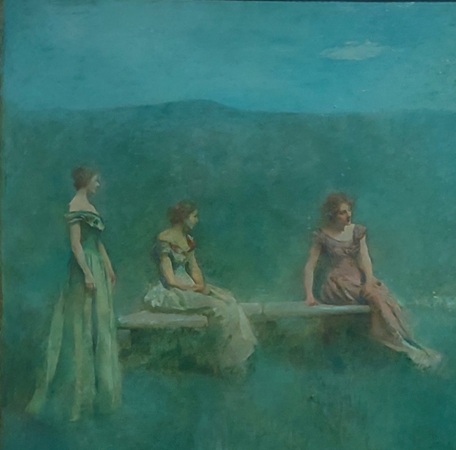
Closeup of La Pêche (1901-1904) by TW Dewing
The Met, photo by cjverb (2025)
The entire scene appears to be out of focus as if it’s a dreamscape or we’re looking through a foggy window. Note how the edges of the women’s dresses, hair, and even the face of the woman on the far left, blur into the natural world surrounding them. These women are fading into the scenery.
La Pêche (1901-1904) by Thomas Wilmer Dewing
Metropolitan Museum of Art, photo by cjverb (2025)
La Pêche de Riches: La Pêche is an idyllic scene, one where the idle, turn-of-the-century rich “fish” and “commune with nature”, but this version of the natural world is a fantasy. It is tame and well-manicured. There are no whining mosquitos, slimy fish or other creepy crawlies to disturb its blissful vibe. And the women are not fishing, instead they look as if they have stepped out of a ballroom. Perhaps they are engaged in another type of fishing…fishing for information? Compliments? Or something else entirely.
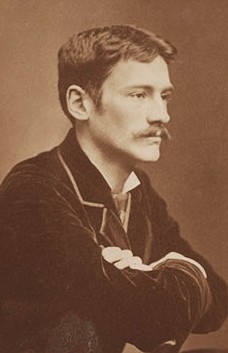
Thomas Wilmer Dewing (1851-1938),
date & photographer unknown, Wikimedia
Impressionable: Thomas Wilmer Dewing (1851-1938) was born in Boston and studied art at the Académie Julian in Paris. He subsequently moved to New York City and in the late 1890s, became a founding member of The Ten, a group of 10 turn-of-the-century American Impressionist painters. Dewing is best known for his paintings of wealthy women typically set in lush landscapes or dreamy domestic spaces:
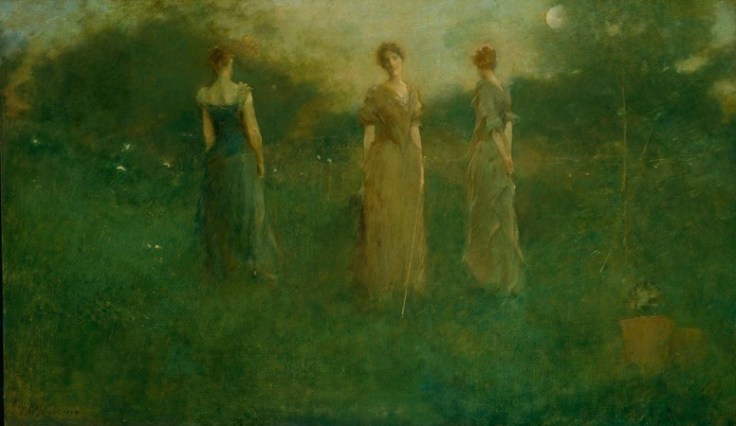
In the Garden (1892-1894) by TW Dewing, Smithsonian American Art Museum
The Gilded Age: Dewing’s art was popular among the wealthy elites of his time. His work was a form of escapism from the major changes the United States was experiencing at the end of the 19th century. Industrialization, urbanization, and immigration were on the rise and in the waning years of the Gilded Age (c1870s-1900), elites lamented these threats to their posh and protected lifestyle portrayed so eloquently in Dewing’s paintings.
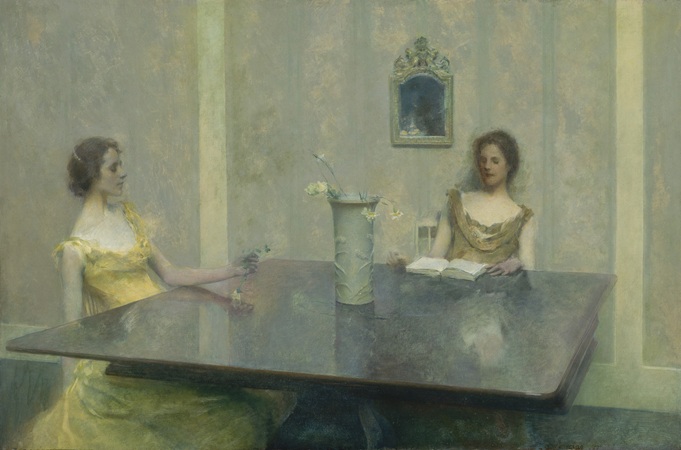
A Reading (1897) by TW Dewing, Smithsonian American Art Museum
Modernity: Like his Gilded-Age patrons, Dewing was also steamrolled by oncoming modernity. By the early 1900s, The Ten were considered old-fashioned and too conservative. A critique of their exhibition in the spring of 1907 was underwhelming.
Ten American Painters: An Average Exhibition by Some Clever Academicians and Others
~Headline from the New York Times, March 25, 1907
Although his artwork received a favorable review, the Times’ art critic was keen to point out Dewing’s outdated subject matter. He described the women in Dewing’s Le Jaseur* (c1907) as, “…huge wracks of overlong bone-ladies who wear low-necked dresses like the elderly ladies at the Court of Queen Victoria…”
*Unfortunately, I was unable to track down an image of Le Jaseur and the “overlong bone-ladies” since many of Dewing’s paintings are in private collections.
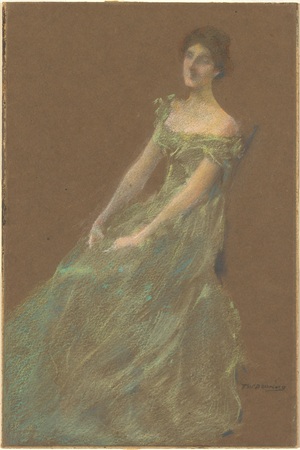
The Green Dress (c1910) by Thomas Wilmer Dewing, National Gallery of Art
Bygones: Like the women in La Pêche, Dewing’s art was beginning to fade. Realism, as well as the experimental art of the Fauves and Cubists, were gaining popularity. Where Dewing’s art focused on the idyllic life of the haves, many of his contemporaries, like those from the Ashcan School, featured the more realistic and grittier life of the have nots. According to the Smithsonian American Art Museum, Dewing stopped painting in the 1920s and he lived in relative obscurity up until his death in 1938. He was 87 years old.
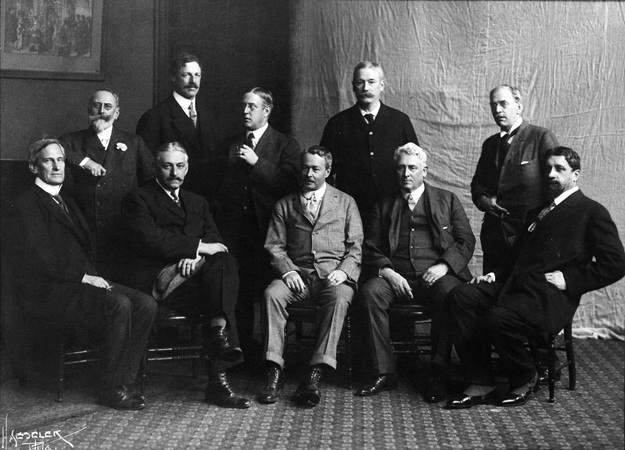
Ten American Painters (1908; TW Dewing is standing 2nd from the right)
Haeseler Photographic Studios, Philadelphia, Smithsonian American Art Museum
Arty Facts
- Dewing was also considered a tonalist, meaning his palette is comprised of colors that are closely related (e.g., blues and greens, or white, gray, and black).
- The Gilded Age (1873) was a novel co-written by Mark Twain and Charles Dudley Warner, that satirizes the corruption of post-Civil War politics.
- The Gilded Age (c1870s-1900) was also an era of US history that got its name from Twain and Warner’s novel. It was a time when the United States experienced extensive economic expansion, was rife with corruption, and the income gap between the small minority of rich and the rest of the population was vast. Click on this Library of Congress: American Business, The Gilded Age and the Progressive Era link to learn more.
That wraps up our look at La Pêche. If you’d like to view more of Thomas Dewing’s work, click on this Collection Arts & Crafts: Thomas Wilmer Dewing Artworks link for a slideshow of his paintings. I’ll be back next week with more Museum Bites, until then be safe, be kind, and take care😊
Sources:
Collection Arts & Crafts: Thomas Wilmer Dewing Artworks
Encyclopedia Britannica: The Ten
Google Arts & Google: Thomas Wilmer Dewing
Library of Congress: American Business, The Gilded Age and the Progressive Era
Mark Twain House & Museum: The Gilded Age (1873) by Mark Twain & Charles Dudley Warner
Metropolitan Museum of Art: The Ashcan School
Metropolitan Museum of Art: The Evening Dress by Thomas Wilmer Dewing
National Gallery of Art: Thomas Wilmer Dewing
National Park Service: The Cornish Colony
New York Times: Ten American Painters an Average Exhibition (1907)
Smithsonian American Art Museum: Thomas Wilmer Dewing
 Museum Bites