The temperatures are rising and today on Museum Bites we’re staying cool with Robert Henri’s, The Beach Hat (1914). Painter, teacher, rebel, and champion of “art for life’s sake”, join me for a closer look at the life and work of this fascinating artist. First, let’s zoom in on the details…
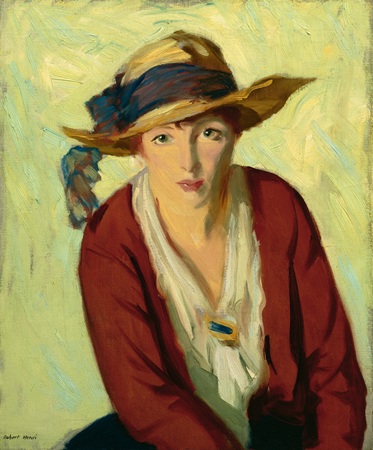
The Beach Hat (1914) by Robert Henri, Detroit Institute of Arts (DIA)
Sister Act: The Beach Hat is a portrait of Violet Organ (died 1959), the artist’s sister-in-law. Violet frequently traveled with her sister, Marjorie, Henri’s wife. This portrait was captured during a visit to California. Starting at the top, note the deep blue scarf wrapped in an elegant knot around Violet’s wide-brimmed hat. One end of the scarf dangles over the edge and casts a shadow on her shoulder. Her bright red hair is tucked beneath the brim, and a wispy curl peeks out near her brow. Violet’s gaze is direct and serious.
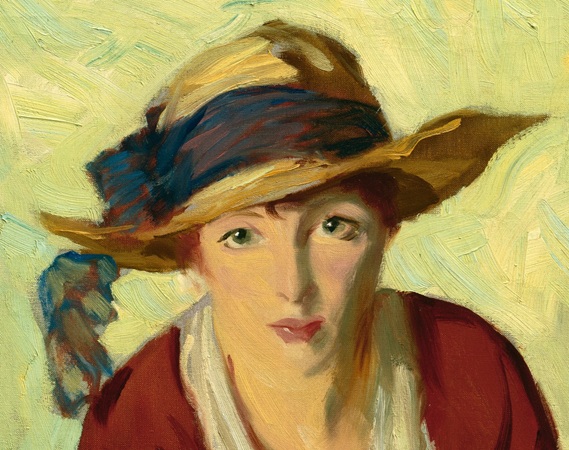
Closeup of The Beach Hat (1914) by Robert Henri, DIA
Keeping it Cool: Violet’s rich red cardigan and silky white blouse are relaxed and unfussy. Her only jewelry is a blue and gold brooch. But where her clothing is comfortable, her posture is atypical and awkward for a portrait. Violet leans slightly forward and to our left, and her hands, which appear to be resting on a knee or thigh, are off the canvas.
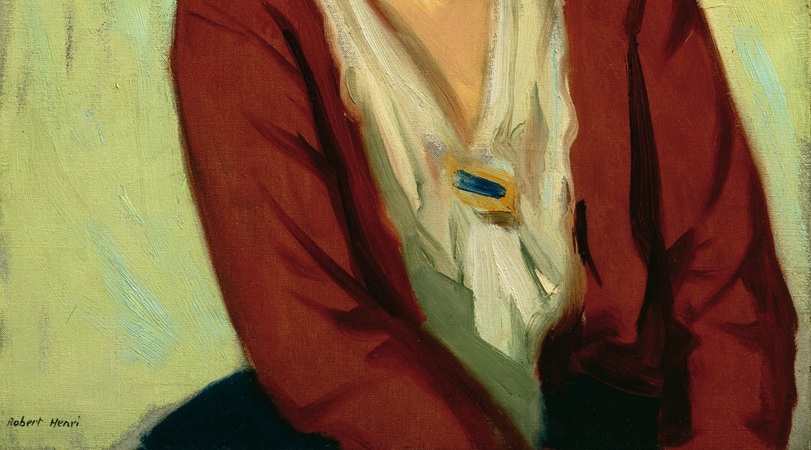
Closeup of The Beach Hat (1914) by Robert Henri, DIA
Soul Sister: It is unclear, especially since the background is nondescript, if she is perched on a stool, sitting crossed-legged, or clutching a knee. Or maybe she’s already at the beach, sinking her toes in the sand. It’s also difficult to determine her mood. Is she content? Exhausted after a long day at the beach or from posing for this portrait? Maybe her brother-in-law is testing her patience. Regardless, Henri’s painting is gorgeous. His title and bright colors suggest a breezy, playful vibe, but Violet’s soulful gaze implies there are deeper layers to this painting. What do you see?
The Beach Hat (1914) by Robert Henri, DIA
On the Road Again: Robert Henry Cozad (1865-1929) was born in Cincinnati, Ohio. His father, John J. Cozad was a real estate developer and former riverboat gambler, who frequently moved the family. When Robert was 17 years old, his father fatally shot a rancher in a land dispute. Fearing retribution, Robert’s parents packed up the family and fled to Atlantic City. They changed their names, and Robert and his brother posed as foster children. His father was eventually exonerated, but Robert kept his new name, Robert Henri.
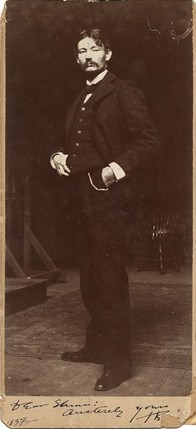
Robert Henri (1897) photographer unknown
Archives of American Art, Smithsonian Institute
Philadelphia Freedom: In his early 20s, Henri enrolled in the Pennsylvania Academy of the Fine Arts in Philadelphia (PAFA). He subsequently studied in Paris and returned in 1891 to begin a lifelong career painting and teaching. His first position was at the School of Design for Women. In 1900, Henri and his first wife, Linda Craige (1875-1905), moved to New York City where he reconnected with several of his artist friends, who like him, shared a passion for capturing scenes of daily life in working- and lower-class neighborhoods.
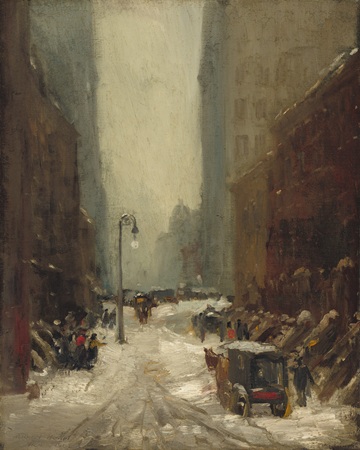
Snow in New York (1902) Robert Henri, National Gallery of Art
Rebel Rebel: In 1906, Henri became a member of the National Academy of Design, an honorary society for artists in the United States. The following year he became frustrated with the Academy’s selection process for its annual exhibition. Henri believed certain artists were being denied because their art had a more modern approach. As was his right, he demanded a revote, but the members clung to their traditionalist criteria. In protest, Henri withdrew his own paintings from the exhibition and the Academy responded by kicking him off their future juries and denied membership to any like-minded artists.
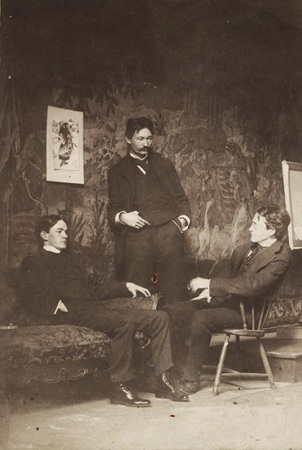
Members of The Eight (left to right), Everett Shinn, Robert Henri & John Sloan (c1896)
Archives of American Art, Smithsonian Institution
The Eight: Not to be outdone, Henri led the charge along with seven of his fellow artists to launch a counter exhibition the following year in New York City. The Eight, as critics called them, sponsored a non-juried exhibition that was controlled by the artists. Their intent was to inspire and promote artistic creativity, as opposed to art that was held to strict standards. During its debut in New York, The Eight’s exhibition was a huge success, bringing in several thousand visitors and touring eight additional cities throughout the East and Midwest. The Eight and their rebellious ways gained more members and they were eventually dubbed the Ashcan School.
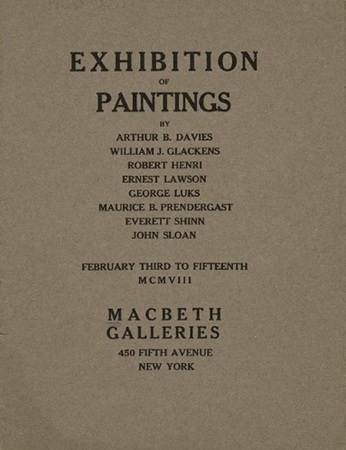
The Eight’s Exhibition of Paintings Program (1908)
Smithsonian Archives of American Art
The Ashcan School: Despite having the same loose brushwork and emphasis on capturing fleeting moments, the Ashcan School was a rejection of Impressionism. Where the Impressionists were bright, idyllic, and often upper class, Ashcan School artists typically featured dark, gritty, and urban working- or lower-classes.
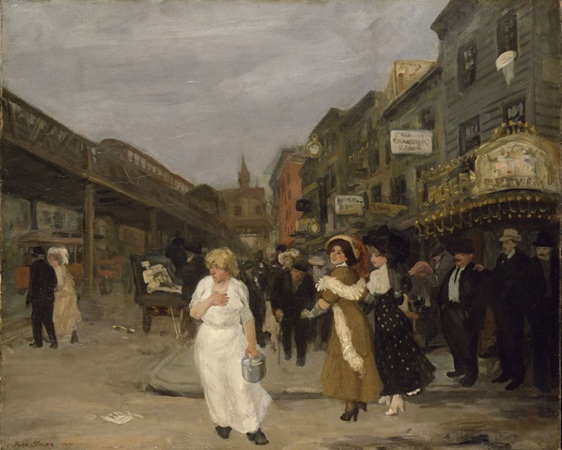
Sixth Avenue and Thirtieth Street, New York City (1907)
by John Sloan, Philadelphia Museum of Art, Wikimedia
In 1910, Henri and his Ashcan pals organized an even larger exhibition. Once again, the event had no jury and awarded no prizes. Over 400 paintings were hung in alphabetical order doing away with any perceived favoritism or criteria on placement. Thousands of visitors attended and Henri and the Ashcan artists paved the way for the groundbreaking 1913 Armory Show.
Avant-Garde: The 1913 Armory Show rocked the American art scene and the impact on Henri and the Ashcan School was significant. Although, he did not play a large role in organizing the show, a subset of the original Eight continued Henri’s desire for a non-juried exhibition that was run by artists.
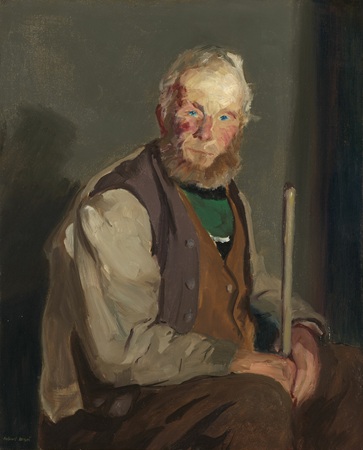
Himself (1913) by Robert Henri, Art Institute of Chicago
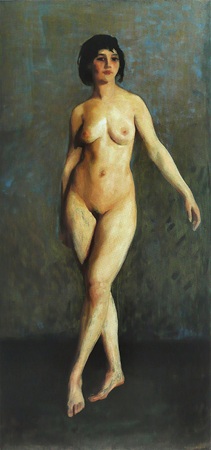
A variety of American and European art was on display, but the work of European modernists like Pablo Picasso, Henri Matisse, and Marcel Duchamp, pushed the boundaries further and challenged traditionalists well beyond Henri and the Ashcan School. Their paintings of urban life, once considered edgy and at times vulgar, were downright mainstream compared to the European modernists. Note on the left, Henri and Duchamp’s differing interpretations of a nude.
Figure in Motion (1913) by Robert Henri
1913 Armory Show
Terra Foundation for Art, Wikimedia
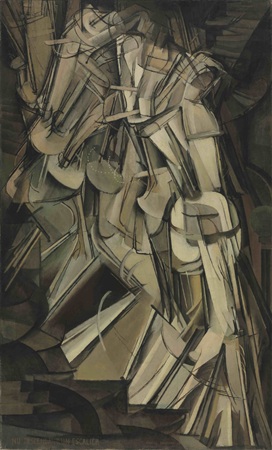
Although their art may have been mocked by critics and the public, these edgy European artists had a significant impact on the direction art would take in the United States as well as abroad. Furthermore, photography had become the medium of choice for documenting those fleeting moments of urban life Henri had captured in his paintings.
Nude Descending a Staircase, No. 2 (1913)
by Marcel Duchamp, 1913 Armory Show
Philadelphia Museum of Art, Wikimedia
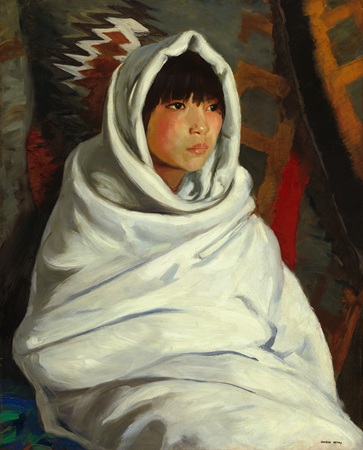
Indian Girl in White Blanket (1917) Robert Henri, National Gallery of Art
Artistic Spirit: Henri persevered, turning more to portraiture and brightening his palette. He also continued to teach. Inspired by his lectures, Margery Ryerson asked Henri if she could compile her notes from his art classes and The Art Spirit was published in 1923. Henri spent the final years of his life painting, teaching, and traveling abroad. In 1928 he was diagnosed with cancer, and he died the following summer in New York City. He was 64 years old. If you’d like to see more of his beautiful art, click on this WikiArt: Robert Henri link.
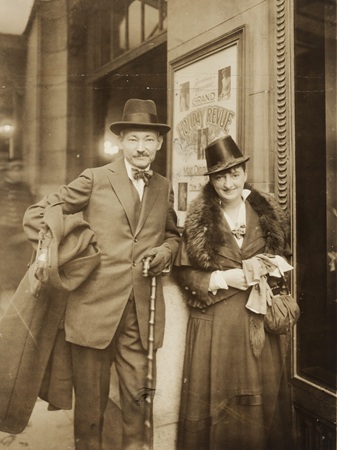
Robert & Marjorie (Organ) Henri (c1920)
photographer unknown, Smithsonian Institute
Arty Facts
- Linda Craige, Robert Henri’s first wife, was a former student. She tragically died in 1905 of gastritis.
- Robert Henri met his second wife, cartoonist Marjorie Organ in 1908 at The Eight exhibition. She died a year after Robert, and Violet inherited Henri’s collection of paintings.
- Marcel Duchamp’s Nude Descending a Staircase, No. 2 (1913) was mocked by many and described by a New York Times reporter as looking like “an explosion in a shingle factory.” Click on this Cleveland Museum of Art: Infamy and Influence to learn more about the painting’s history and Duchamp’s intent.
- The Art Spirit which details Henri’s teachings and philosophy of art is still widely used in art classes today.
That wraps up our look at Robert Henri and The Beach Hat. I’m off on summer break and will be back in September with more Museum Bites. Until then be safe, be kind, take care, and have a fantastic rest of your summer (or winter depending on your hemisphere)😎
Sources:
Archives at Yale: Robert Henri
Cleveland Museum of Art: Infamy and Influence
Detroit Institute of the Arts: The Beach Hat (1914) by Robert Henri
Encyclopedia Britannica: The Eight
Internet Archive Open Library: The Art Spirit (1923) by Robert Henri
Museum of Nebraska Art: Robert Henri
National Gallery of Art: Robert Henri

