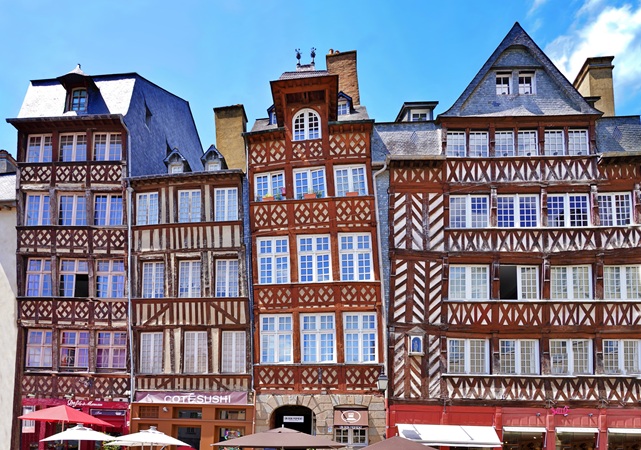
Today on Museum Bites we’re taking a stroll through Normandy’s half-timbered houses. Colorful and a bit wobbly, these fairytale structures are not only charming, their method of construction dates back to ancient Rome. Join me for a tour, but first a little background…
Half-Timbered Buildings (17th century) Rennes, France, photo by ykaiavu, Pixabay
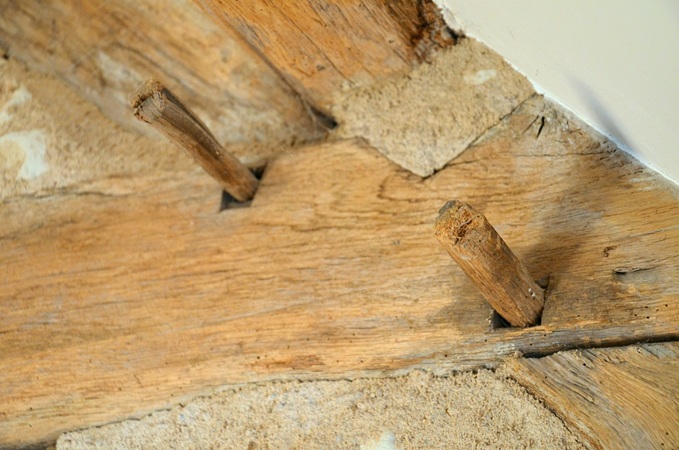
Timber! A popular type of construction throughout medieval Europe, half-timbered buildings are comprised of a wood frame made of squared and exposed timber. The frame utilizes mortise-and-tenon joints that are secured with wooden pegs (dowels). Since wood expands and contracts depending on the amount of moisture it is exposed to, wooden pegs are superior to nails or other metal fittings because they fluctuate with the wood frame. Wooden pegs are also immune to rust and do not suffer from corrosion caused by a frame made of highly acidic wood, such as oak or cedar.
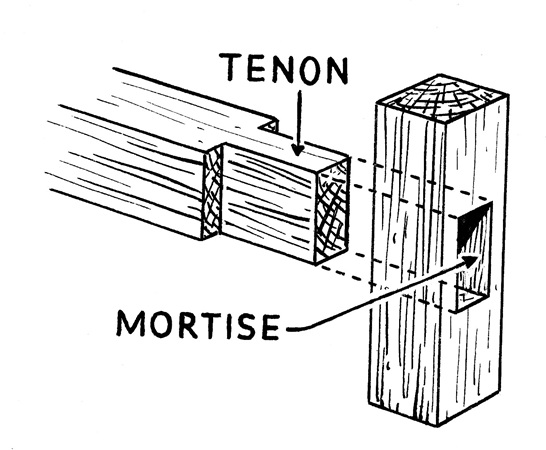
Left: Mortise-and-Tenon Joint by Pearson Scott Foresman, Wikimedia
Right: Mortise-and-Tenon Joint with Wooden Dowels in Pre-Modern French Roof, photo by DC, Wikimedia
Filling: The gaps between the timber are filled with a non-load bearing material such as brick, crushed stone, or a mixture of clay, mud, sand, lime, and/or organic material such as animal hair or dung. Wattle and daub is another type of infill where wooden branches (wattle) are woven through vertical wooden stakes and covered with clay or mud (daub). Click on this Building Conservation: Wattle and Daub link to learn more.
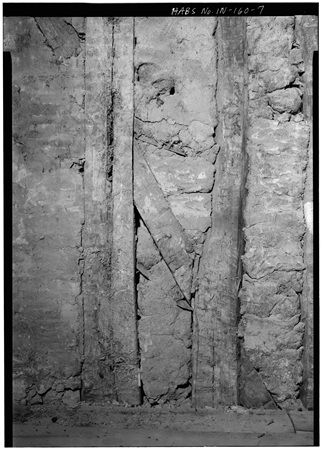
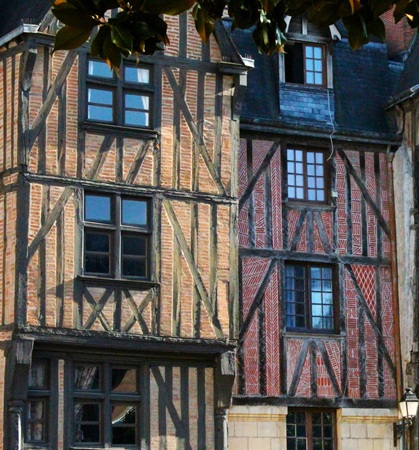
Left: Interior Half-Timbered House, Brouillette House, Vicennes, Indiana, US Library of Congress
Right: Half-Timbered Houses (c15th century), Tours, France, photo (cropped) by Thierry de Villepin, Wikimedia
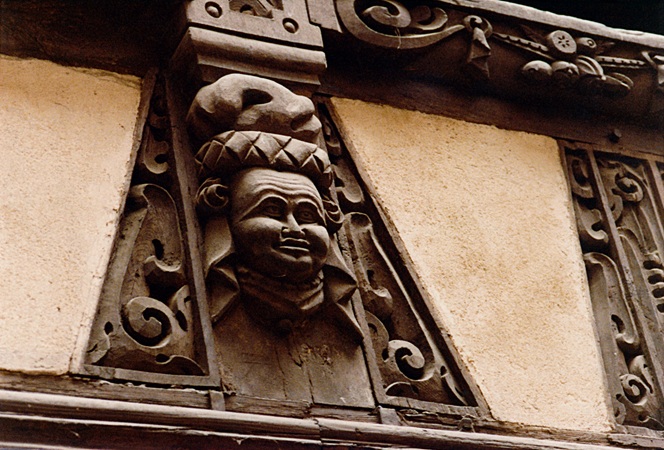
Add More Flair! Traditionally, half-timbered houses had thatched or tiled roofs. Builders also added a dash of flair by carving symbols and/or figures, such as patron saints into the exposed wood. Creating patterns or designs in the infill was also an opportunity for builders to show off their artistic skill. Half-timbered designs can range from the smooth and simple to the eye-wateringly frenetic. In addition, color palettes can be showy, serene, or somewhere in between.
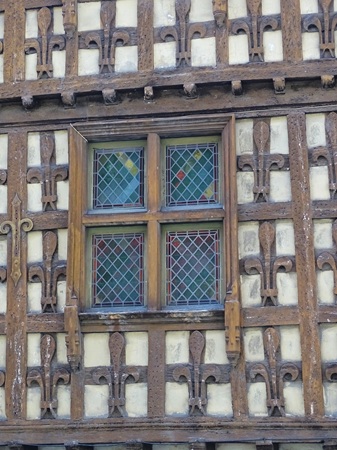
Left: Closeup Maison des Lys à Arreau (16th century) Arreau, France, photo by Selmoval, Wikimedia
Right: Sculpture on Half-Timbered Building, Strasbourg, France, photo by Jean-Pol Grandmont, Wikimedia
Keeping It Local: Historically, builders relied on local materials to construct half-timbered houses. Half-timbering has been used to build modest one-story homes as well as multi-level buildings. Upper levels were often made wider than the ground floor. The resulting overhang increased the square footage, protected the lower level from the elements, and was a clever way to avoid taxes that were based on the amount of ground space a structure occupied.
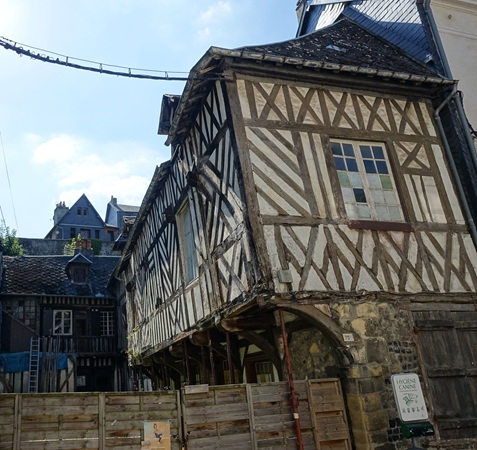
Maison à Colombage, Honfleur, France, photo by Miniwark, Wikimedia
All Roads Lead to Rome: In addition to the architectural feats of the aqueducts, baths, Colosseum, Pantheon and multiple forums, the ancient Romans also constructed the humble half-timbered house or opus craticum. A prime example was excavated from the ruins of Herculaneum in southern Italy. Casa a Graticcio (aka Casa a Opus Craticum) is a two-story, half-timbered Roman home with a second-story balcony and walls that were infilled with crushed rock. Alas, there are no carvings or busy designs, but the timber does retain scorch marks caused by Mt. Vesuvius’ wrath. Click on this Madain Project: Houses of Ancient Herculaneum link to learn more.
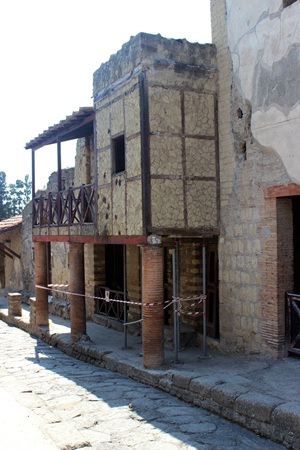
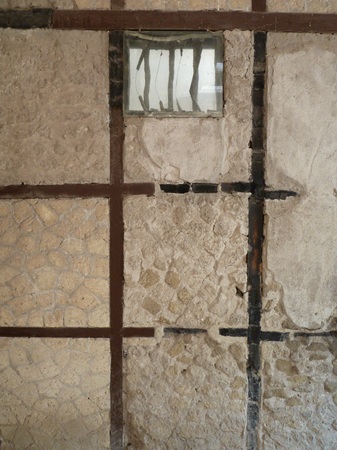
Casa a Graticcio (2nd century BCE-1st century CE), Herculaneum
Exterior photo (left) by Miguel Hermoso Cuesta
Interior photo (right) by Dave & Margie Hill-Kleerup, Wikimedia
Half-Timbering in Honfleur: In France, the maisons à colombage (half-timbered houses) typically have torchis (infill) made of brick or a mixture of clay, lime, straw, and animal hair. Following are some lovely examples I discovered on a recent stroll through the village of Honfleur, located in Northern France. At times I felt like I was in a more laidback version of Duloc sans Shrek, Donkey, and Lord Farquaad’s uptight “perfect world” decrees.
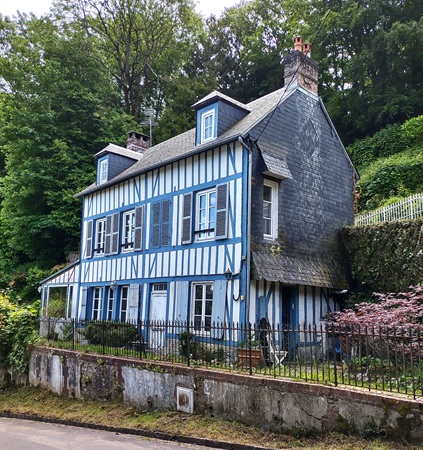
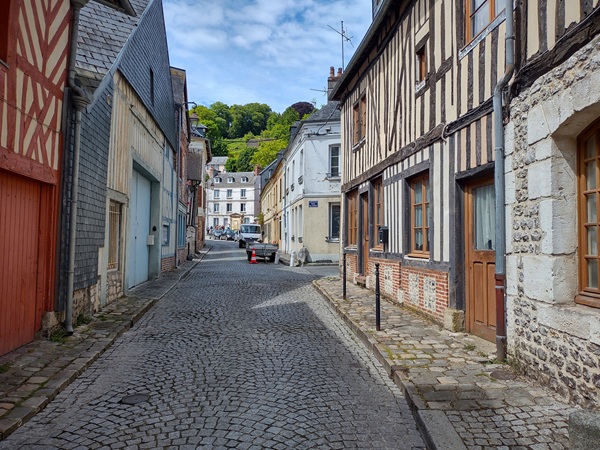
Half-Timbered House (left) and Buildings (right), Honfleur, France, photo by cjverb (2026)
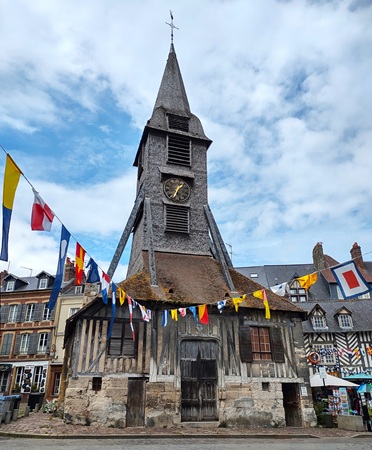
The Church of St. Catherine’s Bell Tower (15th-16th centuries) Honfleur, France, photo by cjverb (2026)
Wonky and weatherworn, these centuries-old structures are not just a visual delight, they also offer us a peek into the past. If you’d like to dig into the details about how half-timbered houses are constructed, click on this fun and informative Skill Builder: Ancient Secrets of Half-Timbered Buildings link. Can’t get enough? Or want to build one of your own? Check out this Deutsche Welle: Building Traditional and Sustainable Half-Timbered Houses link to discover how medieval half-timbered floor plans are being applied to modern home building.

Half-Timbered Houses (c15th century), Tours, France, photo by Thierry de Villepin, Wikimedia
Arty Facts
- Fachwerkhaus refers to a half-timbered house in German. The Deutsche Fachwerkstraße (German Half-Timbered House Road) is a 3,000 km route featuring a plethora of Germany’s version of half-timbered construction, along with other local gems. Click on this Deutsche Fachwerkstraße link to learn more.
- Honfleur was home to French painter, Eugène Boudin (1824-1898) who mentored Claude Monet (1840-1926) and introduced the young artist to painting en plein air (outside).
- According to Wiki Shrek, the fictional city of Duloc is a parody of overly sanitized theme parks like Disneyland and the Magic Kingdom, as well as totalitarian regimes that enforce strict, everything-and-everyone-needs-to-be-perfect rules. If you haven’t seen the movie Shrek (and why haven’t you?!) or want to enjoy this blast from the past, click on this Welcome to Duloc link.
That wraps up our look at half-timbered houses. I’ll be back next week with more Museum Bites, until then, be safe, be kind, and take care😎
Sources:
Architecture Helper: French Architecture Style A Visual Journey
Building Conservation: Wattle & Daub
CompleteFrance: French Architecture Half-Timbered Houses
Deutsche Welle: Building Traditional and Sustainable Half-Timbered Houses
Encyclopedia Britannica: Half-Timber Work
ExploreCalvados: Half-timbering in Normandy
GPS My City: Place du Champ Jacquet
Madain Project: Houses of Ancient Herculaneum
Pixabay: Half-Timbered Buildings, Rennes
Skill Builder: Ancient Secrets of Half-Timbered Buildings
Wikimedia: French Half-Timbered Houses
World History Encyclopedia: The Trellis House in Herculaneum

