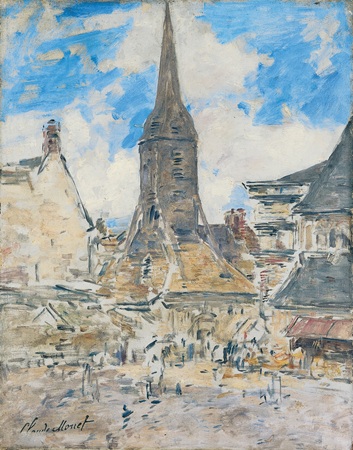
Today on Museum Bites we’re continuing our walkabout through Normandy with a tour of The Bell Tower of Sainte Catherine, Honfleur (c1897). Gifted as a memento, forgotten in storage, and misattributed to a famous artist, this relatively unknown painting has a colorful past. Let’s zoom in for a closer look…
The Bell Tower of Sainte Catherine, Honfleur
Musée Eugène Boudin de Honfleur, Wikimedia
Norman-Gothic: Cast against puffy white clouds and a bright, blue sky, the bell tower of Sainte Catherine’s church, rises above the aptly named St. Catherine’s square. Located in the port town of Honfleur, this unique bell tower was constructed during the late 15th and early 16th centuries.
Closeup of The Bell Tower of Sainte Catherine, Honfleur
Musée Eugène Boudin de Honfleur, Wikimedia
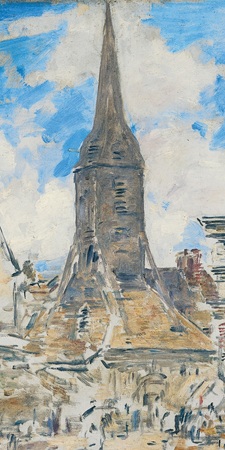
Cleared for Launch: A mishmash of colors and shapes, note its Norman-Gothic architecture, in particular, the spikey steeple, narrow buttresses, and half-timbered walls. The dark steeple, braced by its spindly supports, stretches toward the heavens. It reminds me of a rocket on the launchpad, rumbling and ready to shed its restraints so it can take flight.
Closeup of The Bell Tower of Sainte Catherine, Honfleur
Musée Eugène Boudin de Honfleur, Wikimedia
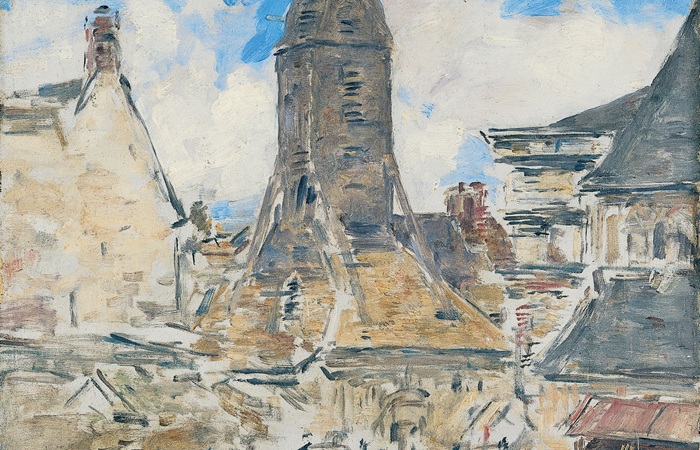
Bustling Blur: Surrounding the bell tower, nondescript buildings, some with red-brick chimneys, blend together. The only exception is a red awning nestled against the church’s half-timbered wall on the lower right. Here the artist adds details, but they are obscure. Is it a vendor’s stall filled with wares or food? A lean-to for livestock? Or something else? The hurried brushstrokes capture the bustle of the square, but aside from the buildings, it is difficult to distinguish people and other objects in the painting.
Closeup of The Bell Tower of Sainte Catherine, Honfleur
Musée Eugène Boudin de Honfleur, Wikimedia
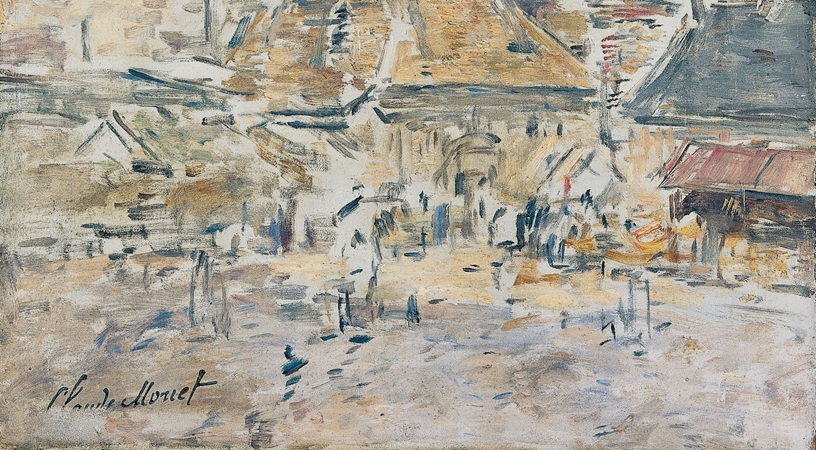
Finally, the signature on the lower left indicates The Bell Tower was created by Claude Monet, but more than a century after its completion, serious doubt has been cast upon this claim.
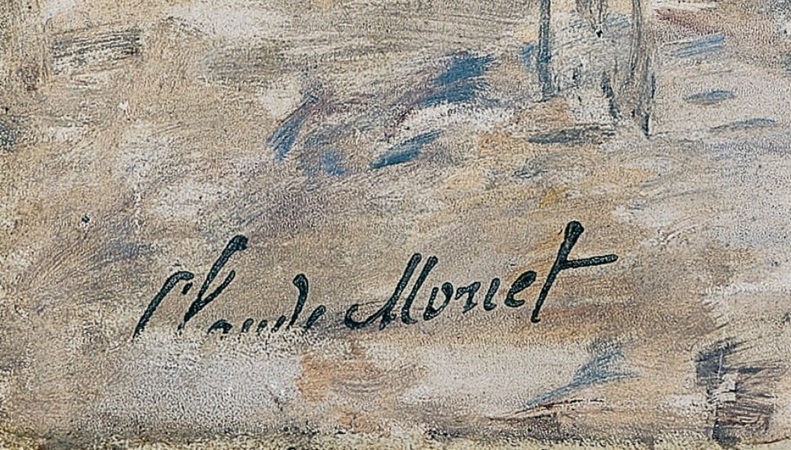
Closeup of The Bell Tower of Sainte Catherine, Honfleur
Musée Eugène Boudin de Honfleur, Wikimedia
Odd Impression: Almost 40 years after Claude Monet’s death, his son, Michel donated The Bell Tower of Sainte-Catherine, Honfleur to the Musée Eugène Boudin, a local art museum in Honfleur. The Bell Tower was considered an oddity by art experts because it was painted on wood, a medium Monet did not use. It also lacked a date, and Michel could not provide additional details about the artwork. Thus, classifying The Bell Tower within Monet’s vast amount of work proved difficult. Anomalies aside, the museum proudly displayed the painting. And who could blame them? It was a Monet! …Or was it?
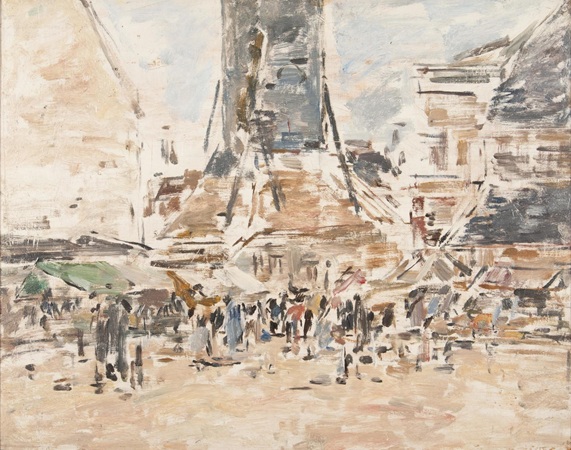
St. Catherine’s Market at Honfleur (c1890) by Eugène Boudin
University of Michigan Museum of Art, Wikimedia
The Paint Thickens: Fast forward to the early 2010s and a Paris exhibition featuring the works of French painter and Honfleur native, Eugène Boudin. Sound familiar? Boudin is the namesake of the Honfleur art museum where The Bell Tower had been on display for almost 50 years. In preparation for the Paris exhibition, curators discovered a painting by Boudin that is remarkably similar to Monet’s undated Bell Tower. The oil-on-wood painting, St. Catherine’s Market at Honfleur had been tucked away in the collections of the University of Michigan’s Museum of Art (UMMA).
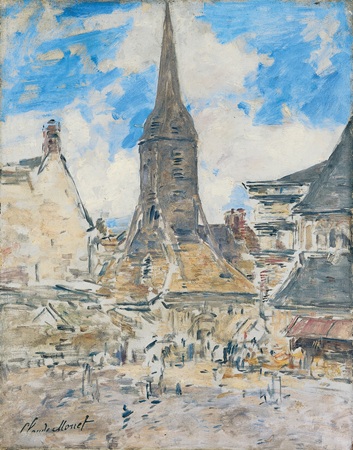
The Bell Tower of Sainte Catherine, Honfleur
Musée Eugène Boudin de Honfleur, Wikimedia
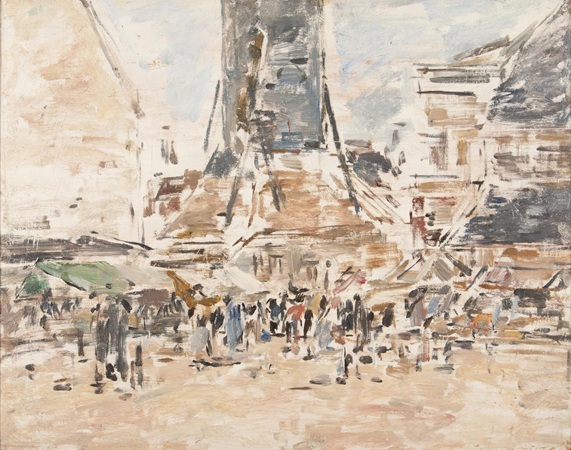
St. Catherine’s Market at Honfleur (c1890)
by Eugène Boudin, UMMA, Wikimedia
Intrepid Art Historians: Boudin frequently painted on wood, and a detailed analysis of the two paintings found striking similarities in the brushstrokes as well as the subject matter. Hot on the trail, intrepid curators dug into Boudin’s correspondence for more clues and they came across a letter Boudin had penned to his brother, Louis. In it, he discusses a trip to Honfleur and painting St. Catherine’s market square where the iconic bell tower resides.
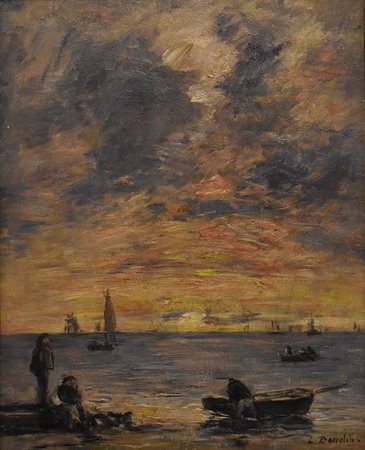
The Sea, Sunset (1883-1887) by Eugène Boudin
Musee d’Orsay, Wikimedia
All Roads Lead to Honfleur! Nicknamed the “king of the skies” for his breathtaking landscape paintings, Eugène Boudin (1824-1898) was drawn to the sea. As a young boy, he helped his father, a harbor pilot, ferry passengers and goods between Honfleur and Le Harve. At age 12, he took a job as a framing assistant where he mingled with artists who saw his potential and encouraged him to pursue a career in art. Primarily self-taught, Boudin obtained a scholarship to study art in Paris. He spent many hours outside painting beach scenes and harbors in and around the little villages near his hometown of Honfleur.
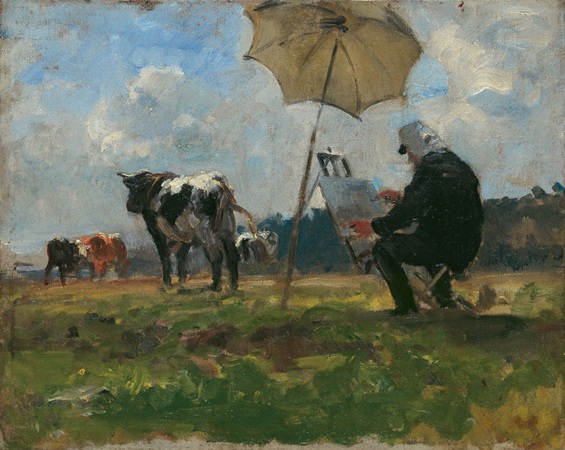
The painter Eugène Boudin painting animals in the meadow at Deauville (1880)
by Henri Michel Lévy, Musée d’art moderne André Malraux, Wikimedia
Making an Impression(ist): In the late 1850s, he met a teenage Claude Monet, who at the time was dabbling in caricature sketches. Boudin encouraged Monet to join him and paint en plein air (outside), a practice that decades later would become fundamental to Monet and his fellow Impressionists.
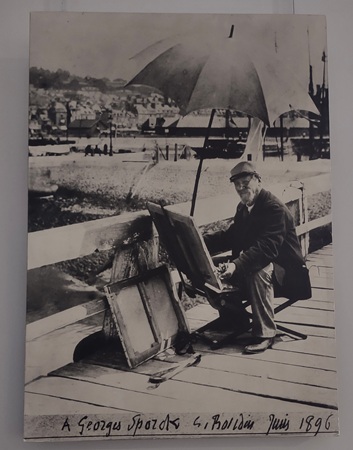
Eugène Boudin Painting En Plein Air in Trouville-Deauville (1896)
by A. Georges Spozok, Musée Eugène Boudin, photo by cjverb (2026)
For Whom the Bell Tolls: Over the course of his career, Boudin received several awards and distinguished honors for his art. In 1897, he made a final pilgrimage to his hometown, Honfleur, and after a day’s walk around the village, he set up his easel and painted the bell tower. The following year, Boudin died of cancer in the seaside town of Deauville. His dying wish was to have his bed moved outside so he could take his last breaths near the sea. Boudin was 74 years old.
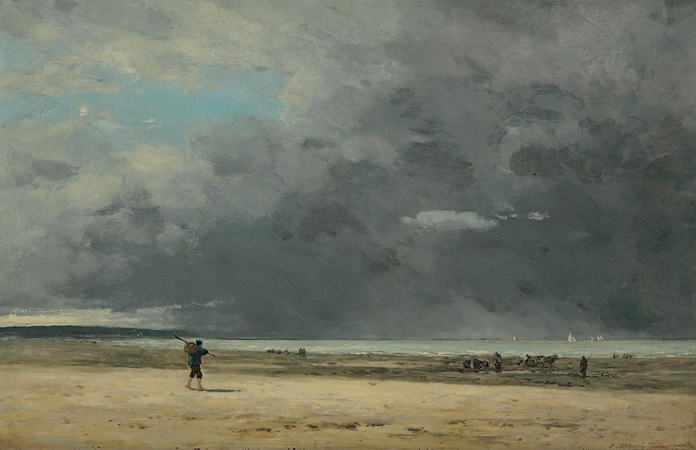
Deauville, Low Tide (c1860-1865) by Eugène Boudin, Wikimedia
Thus it was, that Boudin – with his inexhaustible kindness – took it upon himself to educate me. With time, my eyes began to open and I really started to understand nature. I also learned to love it. I would analyze its forms with my pencil. I would study its colorations.
~ Claude Monet
Claude Monet by Himself (1905) by Thiébault-Sisson, Le Temps
Epilogue: Pourquoi Ce Faux Pas? So how did Monet’s signature end up on Boudin’s Bell Tower? After the painting was complete, it was sent to Monet as a memento. A gift from his former mentor. Eventually, it ended up in storage at Monet’s home in Giverny. After Monet died, Michel cataloged his father’s works. Assuming the unsigned painting was made by his father, he stamped Claude’s signature on it. An honest mistake. The painting remained in Michel’s private collection until 1964 when he donated it to the Eugène Boudin Museum.
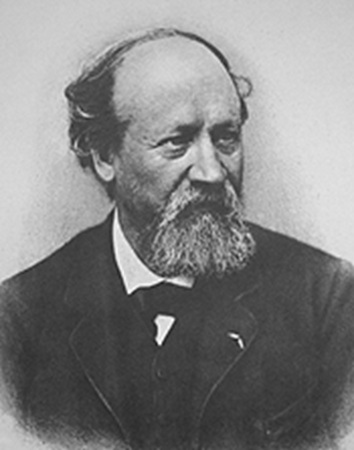
Left: Eugène Boudin (c1880s) photographer unknown, Wikimedia
Center: The Bell Tower of Sainte Catherine, Honfleur (c1897), Musée Eugène Boudin de Honfleur, Wikimedia
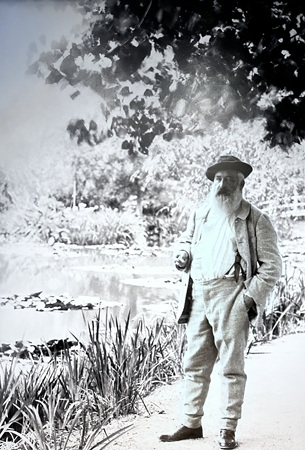
Right: Claude Monet beside the Water Lily Pond, Giverny (1905), photo Jacques-Ernest Bulloz, Cleveland Museum of Art, Wikimedia
Once believed to be the more famous protégé’s artwork, The Bell Tower of Sainte Catherine, Honfleur hung for decades on the walls of the museum that was named for and celebrates the actual artist. Fortunately, dedicated art historians have set the record straight. If you’d like to see more of Eugène Boudin’s work, click on this WikiArt: Eugène Boudin link.
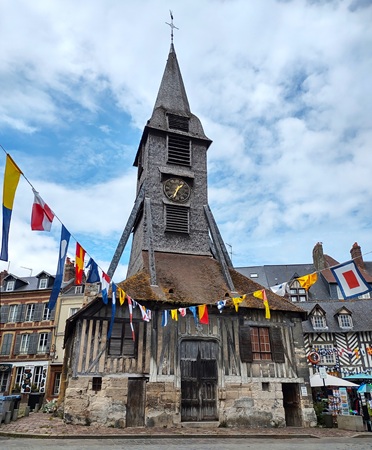
Bell Tower of St. Catherine’s Church (15th-16th centuries)
Honfleur, France, photo by cjverb (2026)
Arty Facts
- Because of its vast height and potential for lightning strikes, St. Catherine’s wooden bell tower was built separately and located across the square, from the church.
- Lacking an architect, the citizens of Honfleur enlisted local shipbuilders to construct St. Catherine’s bell tower and church. Inside both structures resemble an inverted wooden ship. Click on this St. Catherine’s Bell Tower & Church link courtesy of Goosewing_Timberworks and scroll through the photos for a fascinating look inside.
- In 1874, Eugène Boudin exhibited 13 works along with Claude Monet, at the now famous Anonymous Society of Painters, Sculptors, and Printmakers exhibition in Paris. The radical style of painting on display caused an uproar in the art world and launched the Impressionist movement. Although Boudin mentored Monet and introduced him to certain techniques that would define Impressionism, Boudin was not one of the leaders of this movement. Click on this Museum Bites: Coloring Outside the Lines link to learn more.
That wraps up our look at Eugène Boudin’s The Bell Tower of Sainte-Catherine, Honfleur. I’ll be back next week with more Museum Bites, until then, be safe, be kind, and take care😎
Sources:
Encyclopedia Britannica: Eugène Boudin
Giverny News: Tiens, voilà un Boudin
Giverny.org: Transcript of Claude Monet Interview in Le Temps (Nov. 26, 1900)
Instagram: Goosewing_Timberworks: St. Catherine’s Bell Tower & Church Honfleur
LeFigaro: Ce n’était pas Monet, c’était Boudin!
LeFigaro: Eugène Boudin, un chevalet sur la plage
Merriam-Webster Dictionary: Aabat-son
Musée d’art moderne André Malraux: Eugène Boudin National Public Radio: Eugene Boudin: The Man Who Inspired Monet
National Gallery of Art Picturing France: Eugène Boudin
National Public Radio: Eugène Boudin: The Man Who Inspired Monet
New York Times: In Honfleur, the Essence of Normandy
The National Gallery: Eugène Boudin
University of Michigan Museum of Art: St. Catherine’s Market at Honfleur (c1890) by Eugène Boudin

