Wedding bells are ringing and today on Museum Bites we’re celebrating with The Marriage of the Virgin (1504) by Pietro Vannucci. Inspired by biblical fan fiction, looted by Napoleon, and snubbed by the Louvre, this lovely painting has a miraculous story to tell. Let’s dive in.
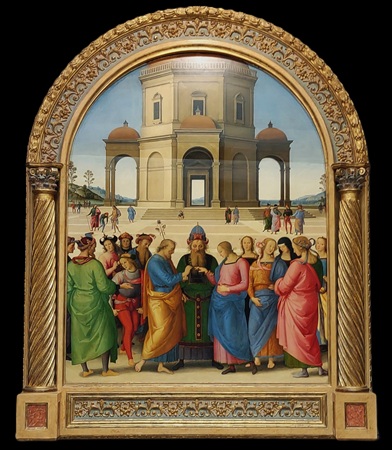
The Marriage of the Virgin (1504) by Pietro Vannucci (Perugino)
Musée des Beaux Arts de Caen, photo by cjverb (2026)
Fan Fiction: The Marriage of the Virgin captures a scene from The Golden Legend (1261-1266), a medieval collection of stories about the lives of the saints and other biblical figures. According to the text, God selected the Virgin Mary’s husband by having potential suitors present wooden rods to the high priest, Zecharia. The rod that flowered was deemed God’s divine choice. Joseph, a humble carpenter, was blessed with the flowering rod and the couple were promptly married. Let’s take a closer look at Pietro Vannucci’s (aka Perugino) interpretation.
The Golden Legend Vol V, photo by Internet Archive
Blushing Bride: In the foreground, the wedding nuptials are in full swing. Front and center, Zecharia joins Mary and Joseph’s hands. Joseph, who is still clutching his winning rod (note the flowery tip) is about to slip a wedding ring on his bride’s finger. With a hand pressed to her stomach, Mary demurely accepts the ring.
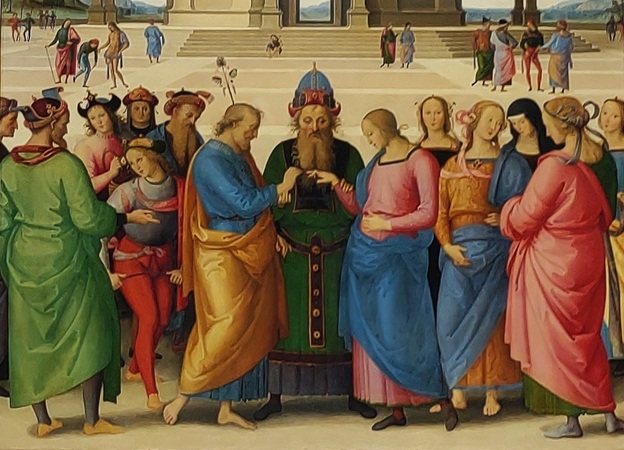
Closeup of The Marriage of the Virgin (1504) by Perugino
Musée des Beaux Arts de Caen, photo by cjverb (2026)
Colorful Guests: The wedding party is dressed in colorful, contemporary clothing (i.e., early 16th century Italian). On the right are Mary’s female attendants and fellow virgins. On the left, are Mary’s rejected suitors. Note how they cluster around the bride and groom but appear to have no interest in the ceremony. Some appear to be conversing while others are lost in thought. One rejected suitor goes so far as to choose this moment to snap his failed rod. Perhaps he thinks the resounding crack during the highpoint of the ceremony would punctuate his frustration. Perugino provides evidence that difficult guests have plagued weddings for centuries.
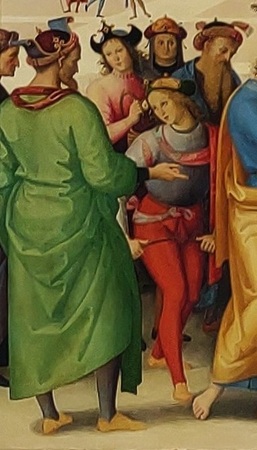
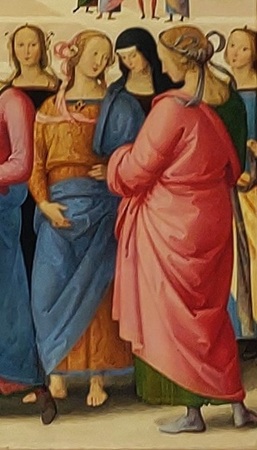
Closeup of The Marriage of the Virgin (1504) by Perugino Musée des Beaux Arts de Caen, photo by cjverb (2026)
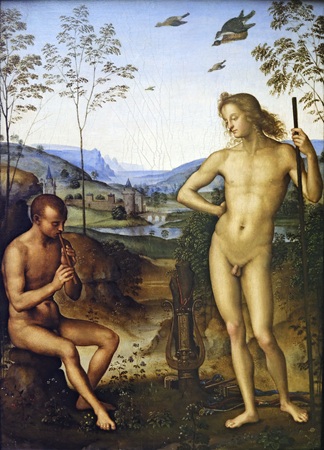
Mystery Guest: Behind the wedding party, people mill about the piazza. All but one scantily clad man on the left, are dressed in contemporary clothing. He appears to be comforting and/or bracing another rejected suitor who is in the process of trying to snap his nonflowering rod. Most sources fail to identify the shirtless figure, but at least one claims it is Christ with no explanation as to why he is attending his mother’s wedding. The other source states it is an “Apollo-like figure” that has been featured in other Perugino paintings.
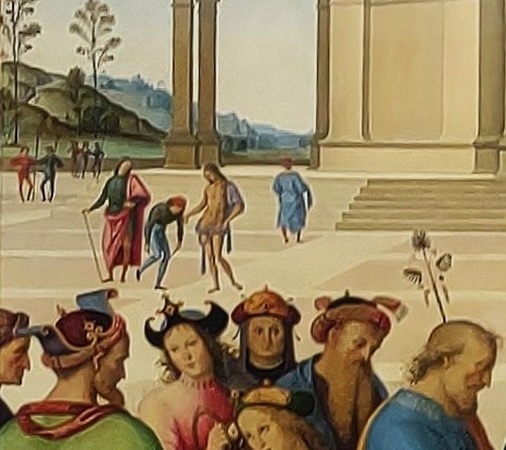
Left: Closeup of The Marriage of the Virgin (1504) by Perugino, Musée des Beaux Arts de Caen, photo by cjverb (2026)
Right: Apollo and Marsyas (1495-1500) by Perugino, Musée du Louvre, photo by Shonagon, Wikimedia
Promised Land: In the background, an octagon-shaped building looms above the piazza. Its perfect proportions are an idealized, Renaissance-version of a temple. The lush landscape beyond is the newly married couple’s symbolic promised land.
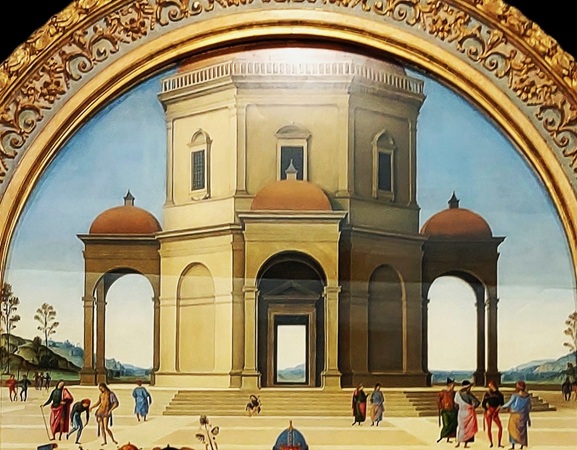
Closeup of The Marriage of the Virgin (1504) by Perugino
Musée des Beaux Arts de Caen, photo by cjverb (2026)
Perugino’s The Marriage of the Virgin is a beautiful example of High Renaissance art which is characterized by balanced compositions, architecture with perfect proportions, and the illusion of depth (i.e., three-dimensionality).
Making of a Master: Pietro Vannucci (c1445-1523) was born in the Città della Pieve in central Italy. He was nicknamed Perugino, because he often painted in the nearby city of Perugia. At age 9 he began an apprenticeship and for many years studied with several well-known Italian masters. Most notably he trained with Andrea del Verrocchio (1435-1488) alongside a young Leonardo da Vinci (1452-1519).
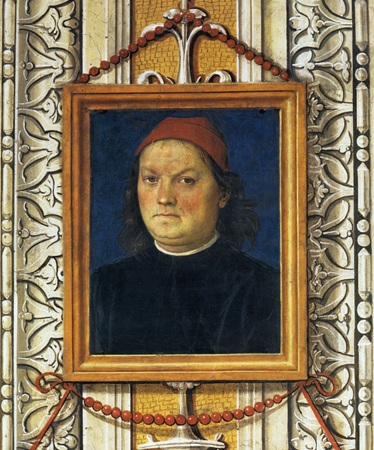
Pietro Perugino Self-Portrait (1496-1500)
Collegio del Cambio, Perugia, Italy, Wikimedia
At the height of his career, Perugino was hailed the best painter in Italy and patrons, particularly the Church, clamored for his services. To meet this demand, he established not one, but two workshops where he trained his own team of apprentices to assist in creating his masterpieces. Perugino’s most famous works are the magnificent frescoes he painted for the Sistine Chapel.
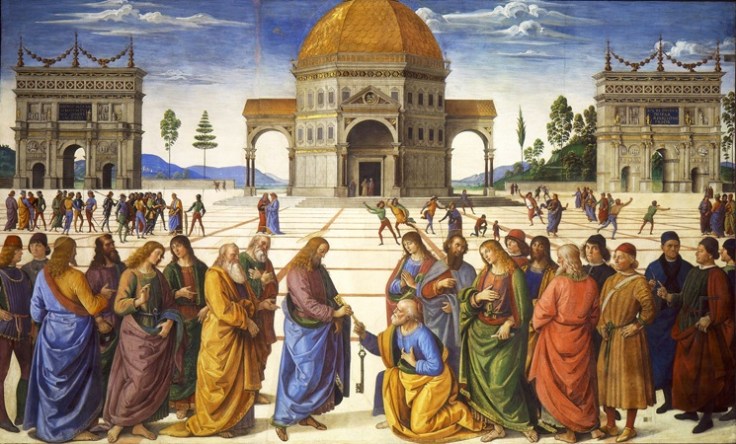
Christ Giving the Keys of the Kingdom to St. Peter (1481-1483)
by Perugino, Sistine Chapel, Wikimedia
Same Old Same Old: Around the time Perugino completed The Marriage of the Virgin, his art began to fade. While his former classmate, Leonardo, was experimenting with different painting techniques and studying human anatomy to make his work appear more lifelike, critics complained Perugino lacked innovation. He was accused of recycling the same old figures (e.g., mystery guest and Apollo/Jesus) and compositions throughout his work. Notice how the landscapes and the varying postures of his figures look similar?
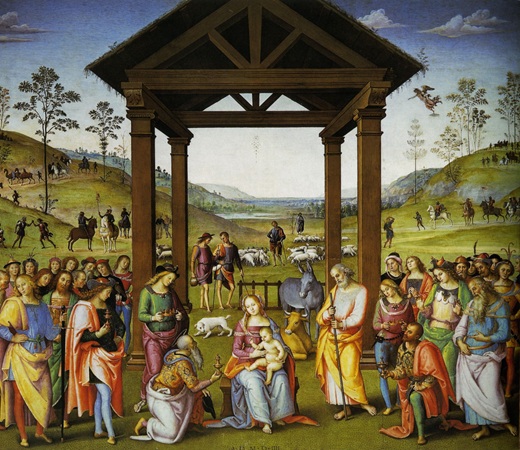
Adoration of the Magi (1504) by Perugino
Oratory of Santa Maria dei Bianchi, Wikimedia
To add injury to insult, Perugino is often eclipsed by his more famous student, Raffaello Sanzio, better known as Raphael (1483-1520). In 1504, the same year Perugino completed The Marriage of the Virgin, a 21-year-old Raphael created his own version. Since their creation art historians have scrutinized and compared the two paintings and Raphael’s version is widely considered superior. In his final years, Perugino returned to work on commission in his beloved Perugia. In 1523, he contracted the plague and died at the age of 78.
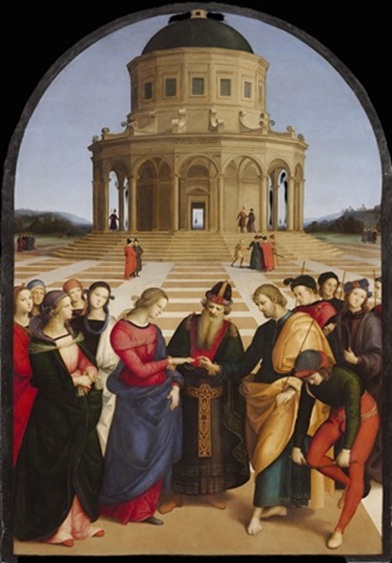
Left: The Marriage of the Virgin (1504) by Pietro Vannucci (Perugino), Musée des Beaux Arts de Caen, photo by cjverb (2026)
Right: The Marriage of the Virgin (1504) by Raffaello Sanzio, Pinacoteca di Brera, Wikimedia
Epilogue – The French Connection: For almost 300 years, The Marriage of the Virgin was on display in the Cathedral of San Lorenzo in Perugia. It was proudly displayed in the chapel that held the Virgin Mary’s supposed wedding ring. In 1797, Napoleon and his army invaded Perugia. The Marriage of the Virgin along with many other artworks across Italy were seized by officials from the French government as part of their campaign to loot art from conquered territories across Europe. Sent to Paris as the spoils of war, the painting was snubbed by the director of the Louvre. In 1804, it was put on display at the Musée des Beaux Arts de Caen, where it remains to today. Efforts to have the painting returned to Perugia have so far been unsuccessful.
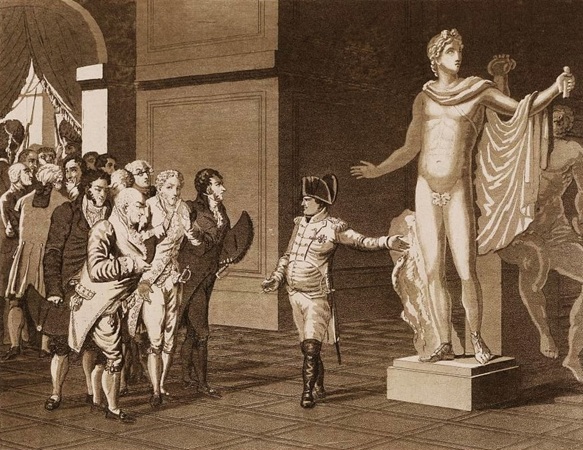
Napoleon Bonapart showing off the Apollo del Belvedere stolen from
the Vatican (1797) by de Vinck, Library of Congress, Wikimedia
Arty Facts
- Perugino’s wife, Chiara (Clara) Fancelli (died 1541) became his muse and model for many of his works, most notably his images of the Virgin Mary.
- In 2004, the Cathedral of San Lorenzo conducted a gemological analysis of the Santo Anello (i.e., Mary’s wedding ring). The results indicate it is a 1st century CE signet ring. Click on this Cathedral of San Lorenzo: The “Mater Gratiae” and the “Holy Ring” link for more details.
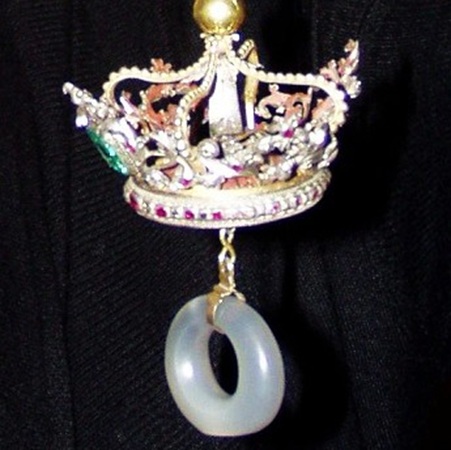
Santa Anello (Holy Ring) Cathedral di San Lorenzo Perugia
photo by Fm2001, Wikimedia
Want more? Click on The Golden Legend Volume 5: The Nativity of Our Lady link if you’d like to read a more detailed version of Joseph and Mary’s nuptials. If you’d like to learn more about the characteristics of High Renaissance art (and why wouldn’t you?) that uses another famous work by Perugino, click on this SmartHistory: Perugino, Christ Giving the Keys of the Kingdom to St. Peter link. Finally, if you’d like to learn more about Raphael’s version of The Marriage of the Virgin (1504), click on this Museum Bites: Biblical Proportions Quick Bite link.
That concludes our look at Perugino’s The Marriage of the Virgin. I’ll be back next week for one final installment of Museum Bites before I’m off on summer break. Until then, be safe, be kind, and take care😎
Sources:
Cathedral of San Lorenzo: The “Mater Gratiae” and the “Holy Ring”
Columbia University Media Center for Art History: Marriage (Wedding, Betrothal) of the Virgin
Coupe-File Art: Perugino’s Marriage of the Virgin: A Total Masterpiece of Renaissance Art
Internet Archive: Pietro Perugino by Umberto Gnoli
Khan Academy: Napoleon’s Appropriation of Italian Cultural Treasures
Khan Academy: Perugino, Christ Giving the Keys of the Kingdom to St. Peter
Musée des Beaux Arts de Caen: Le Mariage de la Vierge
Museum Bites: Biblical Proportions Quick Bite
Pinacoteca di Brera: The Two Marriages of the Virgin
SmartHistory: Perugino, Christ Giving the Keys of the Kingdom to St. Peter
The Golden Legend Volume 5: The Nativity of Our Lady
The National Gallery: Pietro Perugino
Victoria & Albert Museum: Perugino, and His Rediscovery by the Pre-Raphaelites
Virtual Uffizi: Pietro Vannucci
Wikimedia Commons: Le Mariage de la Vierge


_-_Mus%C3%A9e_des_Beaux-Arts_-_%22Le_Mariage_de_la_Vierge%22_(Pietro_Vannucci_dit_P%C3%A9rugin,_vers_1448-1523)_(48697489691).jpg)