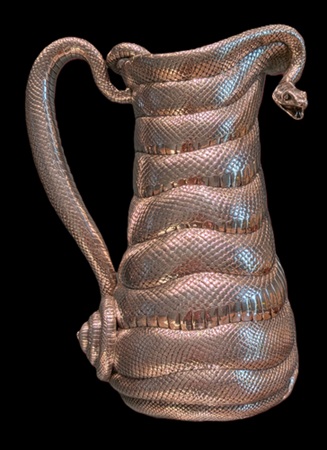
Today on Museum Bites we’re beginning a two-part series on art that comes with a bite. Slithering, scaly, and poised to strike these viperish objects are a sinister treat. Grab some antivenom and let’s dive in! We begin with silvery snakes…
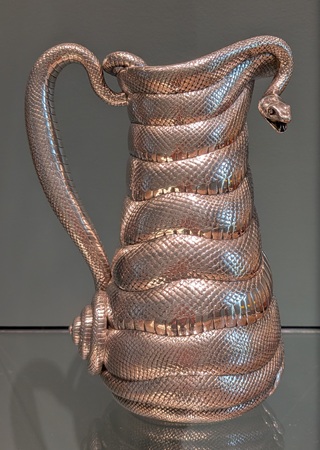
Silver Snake Pitcher (1885) Gorham Manufacturing Company
Providence, Rhode Island, Museum of Fine Arts Boston, photo by cjverb (2026)
Biting Brew: Our first snaky delight is a silver pitcher created by the Gorham Manufacturing Company in 1885. Standing 10 inches tall, this Victorian era vessel was handcrafted to look like a coiled snake. Starting at the top, note how the snake’s neck curves along the edge of the spout. Its cold, black eyes and gaping jaw warn this viper would relish a bite.
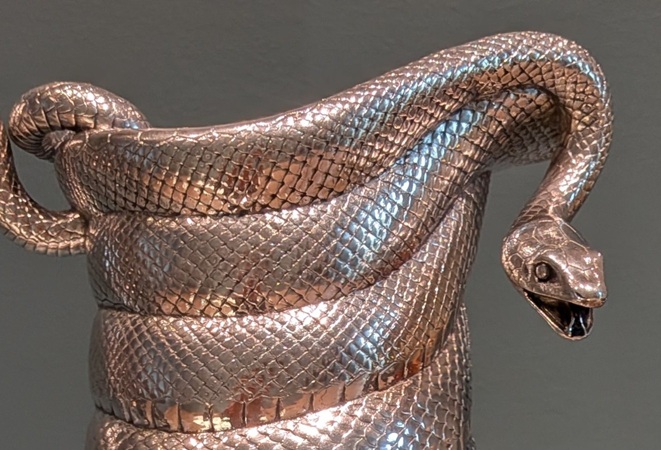
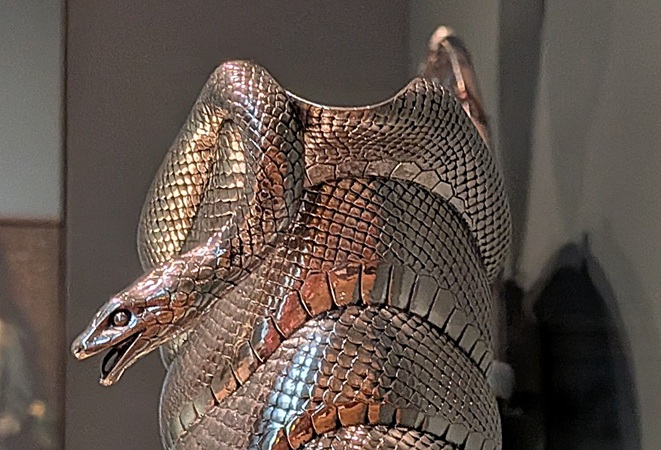
Close-ups of Silver Snake Pitcher (1885) Gorham Manufacturing Company
Museum of Fine Arts Boston, photo by cjverb (2026)
Double Trouble: Wrapped menacingly around the pitcher, the snake’s fleshy body ripples with life. Despite its metallic sheen, the scales and sections of underbelly add to its lifelike appearance. The artist cleverly uses the snake’s tail as the pitcher’s handle. Or do they? When we zoom in for a closer look, you’ll see this pitcher is not one, but two snakes looped together, doubling the creepy cool vibe of this brilliant piece.
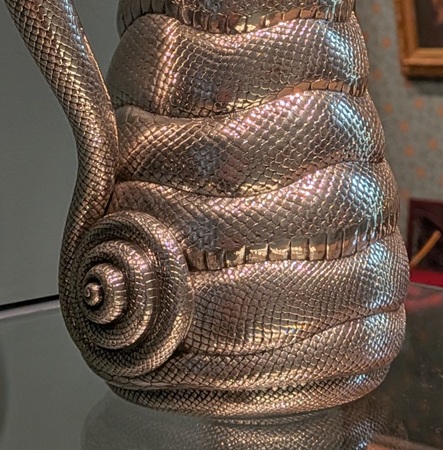
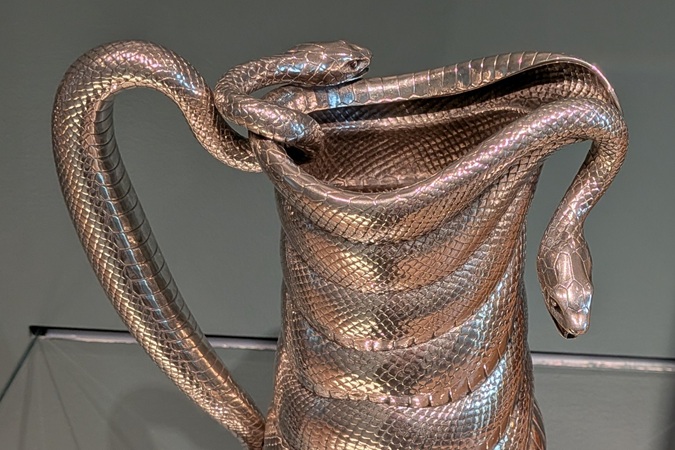
Close-ups of Silver Snake Pitcher (1885) Gorham Manufacturing Company
Museum of Fine Arts Boston, photo by cjverb (2026)
Cleo Cosplay: During the Victorian Era (c1820-1914), the public was fascinated with ancient Egypt and Cleopatra’s method of death by snake. Decorative décor like the Museum of Fine Arts in Boston’s (MFAB) double snake pitcher, were a trendy addition to the Victorian dinner table. It must have also served as a wicked conversation piece, whether that be internal self-talk or a bug-eyed-elbowing-and-mouthing-panicked-words-to-your-fellow-guests type of “talk”. What is the host trying to tell us?! Should we drink whatever’s in that pitcher?! Should have gone with my instincts and declined the invitation to cosplay as Cleopatra…
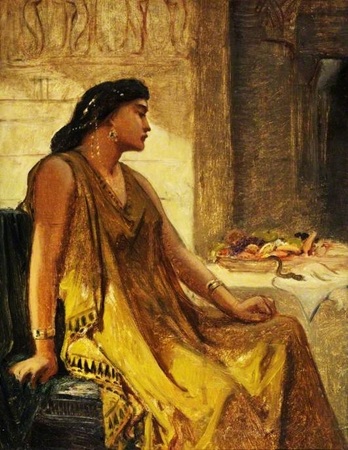
Cleopatra and the Asp (c1880s) by Edward Poynter
Russell-Cotes Art Gallery & Museum, Wikimedia Commons
Silver Wares: The Gorham Manufacturing Company was established in Providence, Rhode Island in 1831 by Jabez Gorham (1792-1869). Jabez began making silver spoons and other household items such as toast racks. In 1850, the company added holloware (e.g., pitchers, bowls, goblets) to its product line and eventually expanded into a global market. Jewelry, silver-clasped handbags, sculpture, and other silver wares were also added.
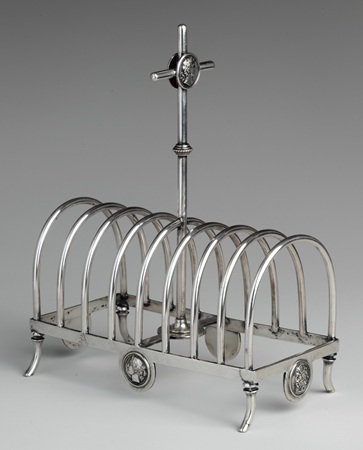
Silver Toast Rack (c1865)
Gorham Manufacturing Company
Metropolitan Museum of Art
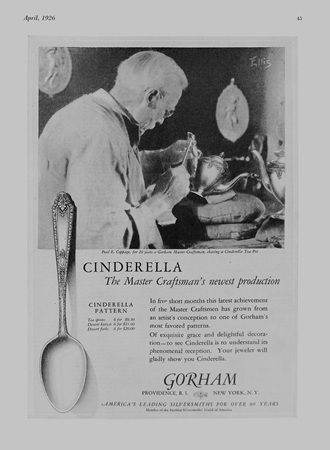
Gorham Manufacturing Ad (1926)
The Elks Magazine, Wikimedia Commons
During the 20th century, ownership of the company changed hands several times and today Gorham is part of a conglomerate that is owned by the Lenox Corporation. Due to licensing agreements, Gorham no longer makes its fine sterling silver, but vintage pieces are highly sought after by collectors. The company’s vintage sterling silver line is identified by Gorham’s “sterling” and trademark stamps of a lion, anchor and Gothic “G”. Click on this Gorham link to learn more.
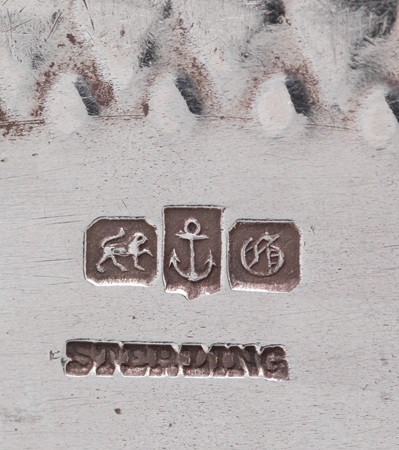
Gorham Manufacturing Company Trademarks (cropped; 1881)
Metropolitan Museum of Art, Wikimedia Commons
Courtly Claret: Our next snaky art is a claret jug handcrafted by Oomersi Mawji (before 1850-c1890), a court silversmith for Maharao Shri Mirza Raja Sawai Khengarji Bahadurno (1866-1942), the ruler of Kutch, a territory located in the modern-day coastal state of Gujarat in northwestern India. Like our previous pitcher, this lovely vessel was also created during the Victorian Era in the mid-1880s.
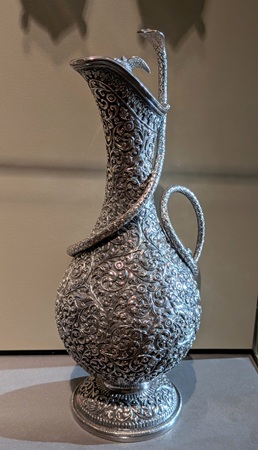
Silver Claret Jug (c1885) by Oomersi Mawji, Bhuj, India
Museum of Fine Arts Boston, photo by cjverb (2026)
Bird is the Word: At 12 inches tall, Mawji’s silver claret jug resembles a goose or a duck. Note how its round belly narrows into a long neck that stretches up to a beaky spout. The entire vessel is covered in an intricate floral design and as we zoom in, note the occasional bird woven into the thick foliage. These are signature Mawji design features.
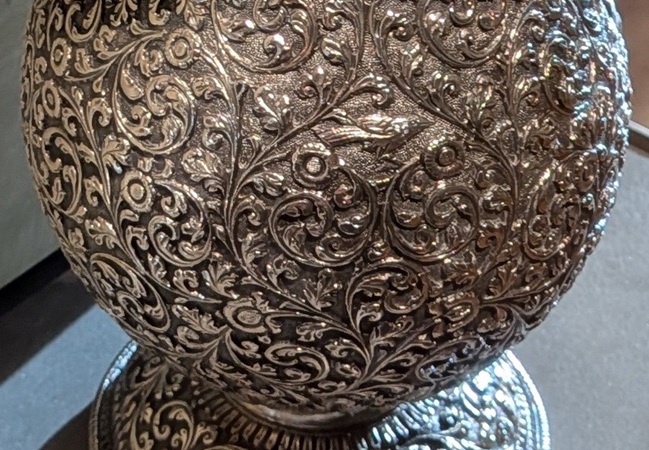
Close-up of Silver Claret Jug (c1885) by Oomersi Mawji
Museum of Fine Arts Boston, photo by cjverb (2026)
Predator and Prey: Zooming back out, it’s hard to miss the cobra wrapped, like a rope (noose?) around the neck of the pitcher. Note the serpent’s deep, overlapping scales and how its tail loops and swoops to form a handle. To add to the sinister vibe, the cobra’s upper body slithers up behind an unsuspecting hawk perched atop the lid. With its wings unfurled it is unclear if the hawk is about to take flight or has just landed in time to be the cobra’s lunch. Like the Gorham snake pitcher, Mawji’s work sets a tone and no doubt made for some interesting dinner conversation.
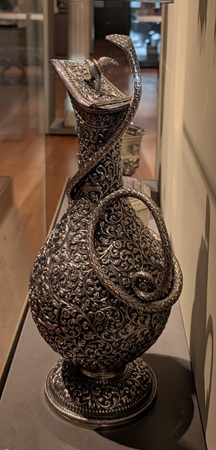
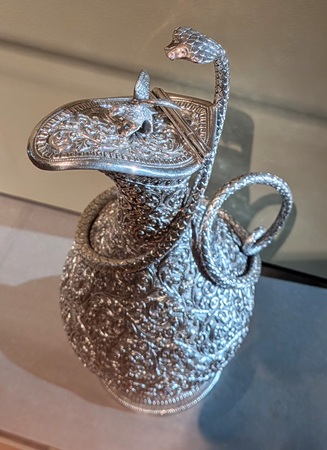
Close-ups of Silver Claret Jug (c1885) by Oomersi Mawji
Museum of Fine Arts Boston, photo by cjverb (2026)
Mawji and Sons: In the 19th century, Kutch was a major center of silverware production for both domestic and foreign markets. Located in the city of Bhuj, Mawji and his sons’ stunning wares were in high demand, particularly among British colonists. Mawji’s work typically featured snakes and motifs of dense foliage with animals and sometimes human figures embedded in the design. He and his sons rarely signed their work although there are a small number of highly coveted pieces that bear the OM or OM Bhuj stamp signifying their authenticity.
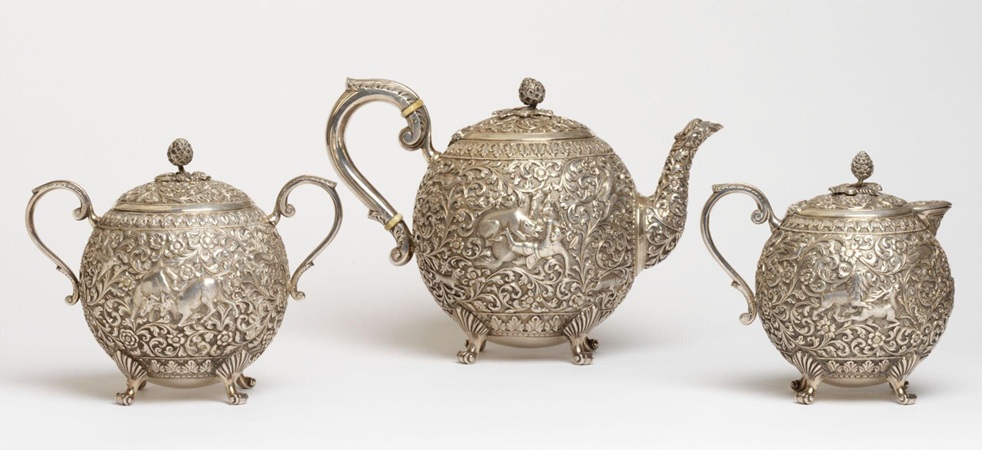
Silver Tea Set (c1880) by Oomersi Mawji, Victoria & Albert Museum
Hammer Time: MFAB’s snake pitchers were handcrafted by techniques called chasing and repoussé. Chasing involves hammering a design onto the front or exterior of a metal object. For holloware like MFAB’s snake jugs, a pitch typically made of hot resin and wax, is poured into the vessel. After the pitch hardens, the silversmith can start chasing. Once complete the pitch is melted, poured out and the smith is ready to repoussé.

Smith Chasing a Copper Vessel (2015) in Medina of Tunis, Tunisia
Photo by Issam Barhoumi, Wikimedia Commons
Push It: Repoussé comes from the French verb pousser which means to push. When smiths repoussé they hammer and/or punch (i.e. push out) a design from the inside or back of a metal object. Once complete, the objects are then cleaned and polished. Together these ancient techniques have produced centuries of gorgeous metalworks. Click on this That Works: Unlocking the Art of Chasing and Repoussé Techniques link if you’d like to watch a detailed demonstration.
Arty Facts
- Holloware is tableware that has depth (i.e. can hold volume) such as pitchers, bowls, and goblets, in contrast to flatware (e.g. forks, knives, spoons).
- For an object to be considered made of sterling silver, it must contain a minimum of 92.5% pure silver.
- Gorham Manufacturing’s lion, anchor and Gothic “G” was trademarked in 1868.
- Domestic buyers in the United Kingdom could order Oomersi Mawji’s wares from catalogs in London.
That wraps up Part 1 of our Serpentine art crawl. I’m heading out on another adventure and will be back in 2 weeks with Part 2. In the meantime, be safe, be kind, and take care🙂
Sources:
Encyclopedia Britannica: Chasing
Encyclopedia Britannica: Jabez Gorham
Encyclopedia Britannica: Repoussé
Encyclopedia Britannica: Sterling
Metropolitan Museum of Art: Silver Coffeepot (1881) by Gorham Manufacturing Company
Metropolitan Museum of Art: Silver Teapot (c1865) by Gorham Manufacturing Company
Metropolitan Museum of Art: Silver Toast Rack (c1865) by Gorham Manufacturing Company
Musée des Beaux-Arts de Marseille: Cleopatra by David Henri Joseph Ducommun du Locle (1852)
Museum of Fine Arts Boston: Silver Claret Jug (c1885) by Oomersi Mawji of Bhuj
Museum of Fine Arts Boston: Snake Pitcher (1885) by Gorham Manufacturing Company
That Works: Unlocking the Art of Chasing and Repoussé Techniques
Victoria & Albert Museum: Silver Tea Set (c1880) by Oomersi Mawji
Wikimedia Commons: Cleopatra and the Asp (c1880s) by Edward Poynter
Wikimedia Commons: Engraving of Gorham Manufacturing Company (1886)
Wikimedia Commons: Gorham Manufacturing Company
Wikimedia Commons: Gorham Manufacturing Company Cinderella Pattern Advertisement (1926)
Wikimedia Commons: Gorham Manufacturing Company Trademarks (1881)
Wikimedia Commons: Smith Chasing a Copper Vessel (2015) by Issam Barhoumi


Leave a Reply