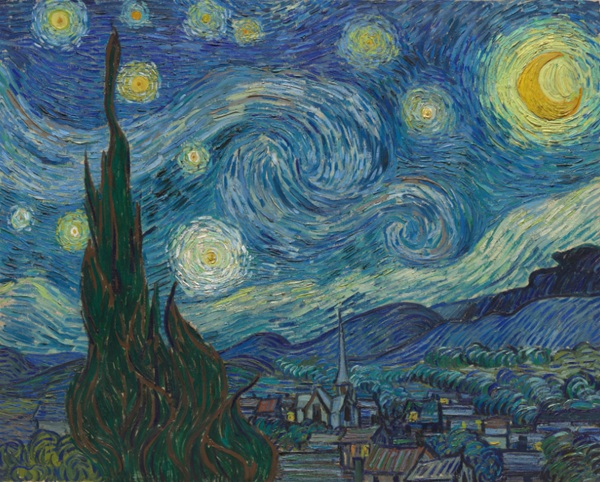
Today on Museum Bites we’re taking a midnight stroll through The Starry Night (1889), by Vincent van Gogh (1853-1890). Featured in countless selfies and plastered on purses and plates, mugs and magnets, as well as ties and tees, van Gogh’s dazzling night sky not only decorates our tchotchkes, it provides a glimpse into the Dutch artist’s inner psyche. Join me for a brief look at the story behind this iconic painting.
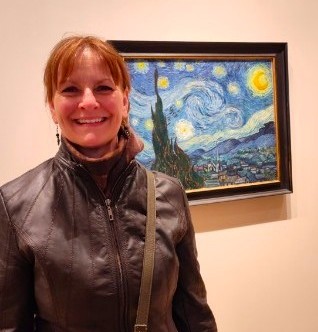
CJ Verb fangirling The Starry Night, photo by NM Verb (2025)
First, let’s take a closer look at the colorful details…
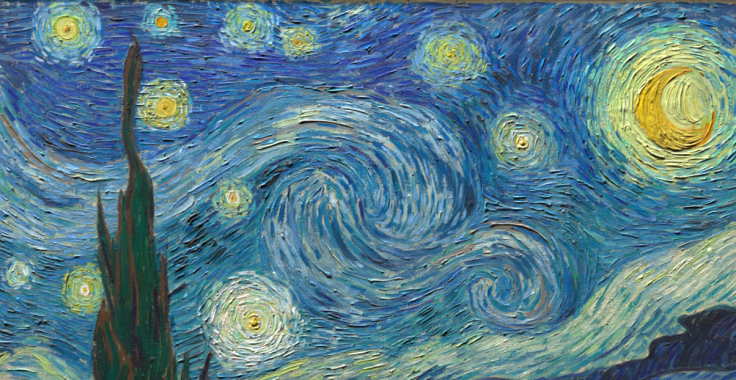
Close-up of The Starry Night (1889) by Vincent van Gogh, MOMA, New York City
Starting at the top (see image above), notice the swirling night sky dotted with brightly shining stars and a brilliant crescent moon. The large white star (low and to the left of center) is the planet, Venus. The sky and especially the stars are painted with a rough, sometimes gloppy texture. This technique is called impasto and involves applying paint to the canvas with thick, heavy strokes by using a brush, palette knife, or squeezing it directly from the paint tube.
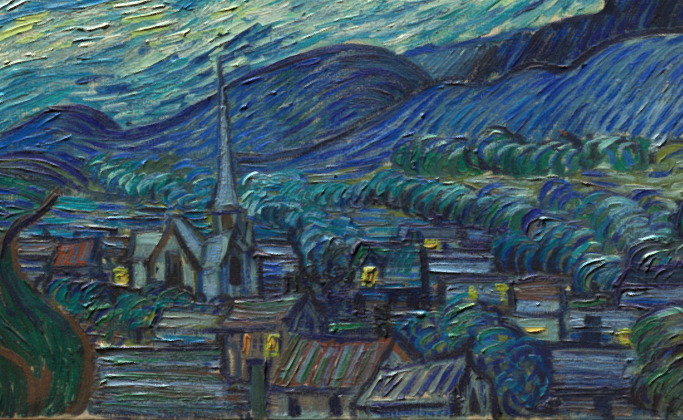
Beneath the blazing sky a sleepy village is nestled among the rolling hills. A soft glow comes from the windows of several houses, but not a single person, aside from the artist, witnesses the drama playing out overhead. Note the brushstrokes on this section of canvas are relatively tame and flat.
Close-up of The Starry Night (1889) by Vincent van Gogh, MOMA, New York City
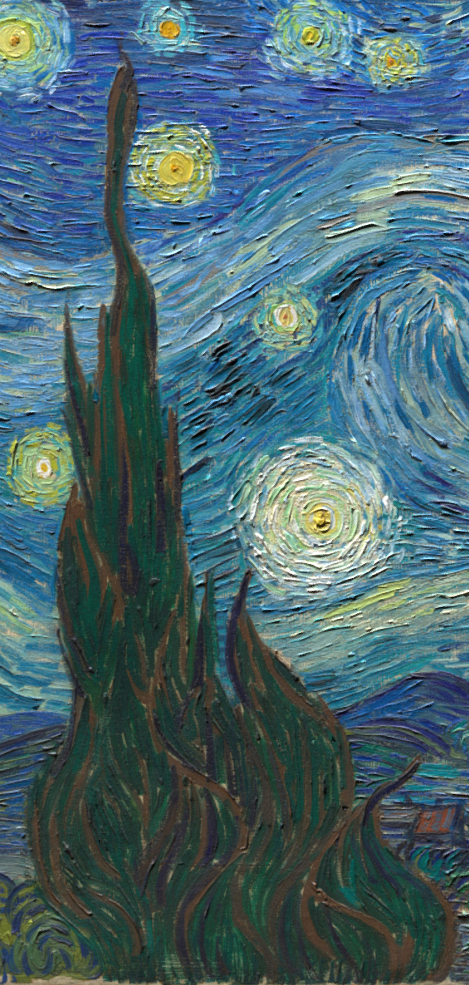
As is the texture of the large cypress tree located on the left side of the canvas. Note how its wavy green branches reach for the stars. Van Gogh was fascinated with cypress trees and stated their “lines and proportions” were similar to an Egyptian obelisk.
Close-up of The Starry Night (1889) by Vincent van Gogh, MOMA, New York City
Impressive Impression: The Starry Night is lush and vibrant. The vivid colors and turbulent sky illustrate the energy and animation van Gogh poured into his work. I imagine him painting like a musical conductor with his arms swooping and hands jabbing paint onto the canvas. Through color, texture, line, and form Vincent gives us a glimpse of his emotional state. You don’t just see The Starry Night, you feel it. It’s a whirling, swirling thrill ride that reminds me of the images we see of the aurora borealis shimmering across the sky.
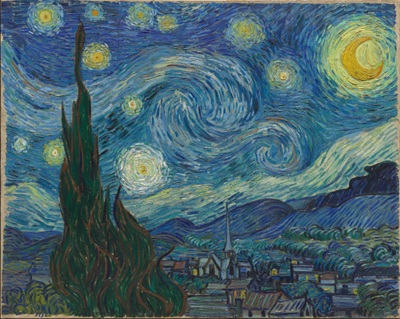

Left: The Starry Night (1890) by Vincent van Gogh, MOMA; Right: Aurora Borealis, Eielson Air Force Base, Alaska, photo by Sr. Airman J. Strang (2005)
Van Gogh’s Vision: The Starry Night was inspired by a combination of views van Gogh observed during his stay at St. Paul de Mausole, a psychiatric hospital in St. Rémy, France. Vincent admitted himself to St. Paul’s several months after he suffered a severe mental breakdown that resulted in him cutting off his ear. Vincent had no memory of the incident.
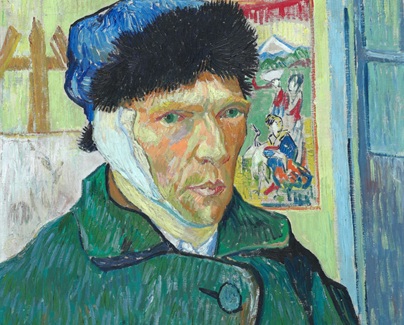
Self-Portrait with Bandaged Ear (1889) by Vincent van Gogh, Van Gogh Museum
Dr. Théophile Peyron, van Gogh’s therapist, supported Vincent’s creativity and prescribed painting and drawing as part of his treatment. After a little more than a month, Vincent painted The Starry Night. During his year-long stay at St. Paul’s, Vincent created 143 paintings and 100 drawings, which included some of his most famous works, such as Irises (1889) and Almond Blossom (1890).
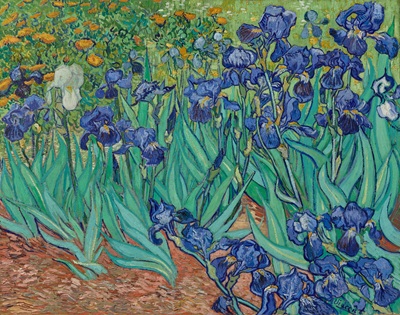
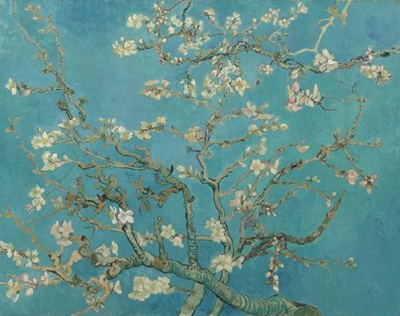
Left: Irises (1889) by Vincent van Gogh, Getty Museum; Right: Apple Blossom (1890) by Vincent van Gogh, Van Gogh Museum
Several months after he left St. Paul’s, Vincent fell into a deep depression. He continued to paint, but worried about his financial future, and feared he would suffer more mental attacks. Tragically, Vincent died of a self-inflicted gunshot wound on July 29, 1890. He was just 37 years old.
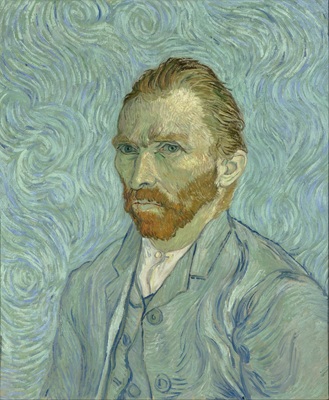
Self-Portrait by Vincent van Gogh (1889), Musée d’Orsay
His paintings were left in the care of his brother, Theo (1857-1891) and sister-in-law, Jo van Gogh-Bonger (1862-1925), who championed Vincent’s work. Their son, Vincent Willem van Gogh (1890-1978) founded the Van Gogh Museum in Amsterdam. If you’d like to learn more about Vincent’s life and the circuitous path he took to become an artist, click on this Museum Bites: Vincent link. If you’d like to see more of Vincent’s art click on this Google Arts & Culture: Vincent van Gogh link.
Arty Facts:
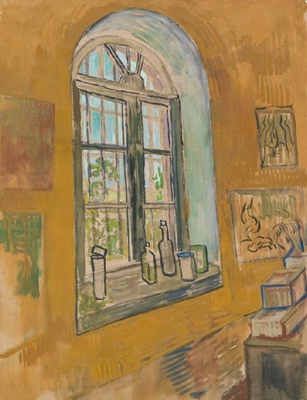
* The Starry Night is not the exact view outside Vincent’s window at St. Paul’s as is commonly thought. Note the painting on the left of his window at St. Paul’s.
* There has been much speculation, but no clear diagnosis for Vincent’s mental affliction. It was not caused by consuming paint.
* St. Paul’s is still a psychiatric hospital today, with art therapy as part of its treatment protocol.
* The Starry Night is an example of Post-Impressionism, an art movement featuring a range of styles, but all convey the emotions and inner psyche of the artist. To learn more click on TheArtStory: Post-Impressionism link.
Window in the Studio (1889) by Vincent van Gogh, Van Gogh Museum
That wraps up our tour through Vincent van Gogh’s, The Starry Night. I’ll be back next week with more Museum Bites, until then be safe, be kind, and take care.
Sources:
Google Arts & Culture: Vincent van Gogh
Museum of Modern Art: The Starry Night (1889)
TheArtStory: Post-Impressionism
Van Gogh Museum: Apple Blossom (1890)
Van Gogh Museum: The Woman Who Made Vincent Famous
 Museum Bites
