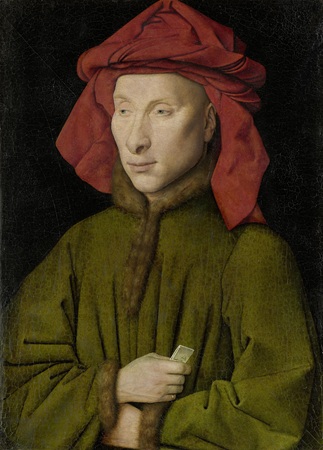
Today on Museum Bites we’re wrapping ourselves in red with a tour through Jan van Eyck’s Portrait of a Man in a Red Chaperon (c1435-1438). At first glance this portrait may appear simple, but it is rich with detail. Join me as we peel back the layers of this fascinating piece to learn more about the art, the artist, and the man in the red chaperon. Let’s begin by zooming in…
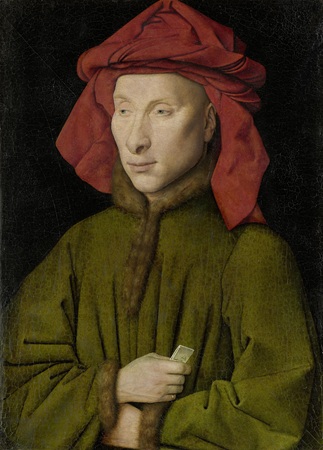
Portrait of a Man in a Red Chaperon (c1435-1438)
by Jan van Eyeck, Gemäldegalerie
This oil-on-wood painting features a well-dressed gentleman wearing an elaborate red headdress called a chaperon. A popular male fashion trend in 15th century Europe, note how van Eyck captured the chaperon’s complicated twists and folds.
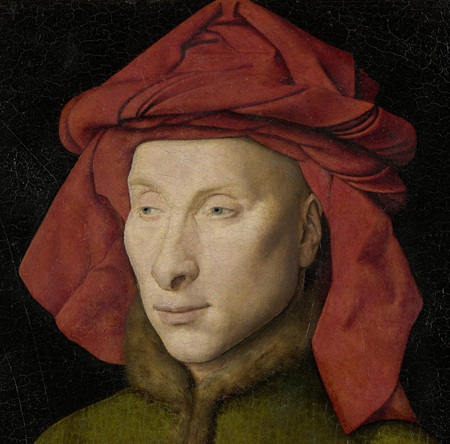
Portrait of a Man in a Red Chaperon (c1435-1438)
by Jan van Eyeck, Gemäldegalerie
Moving down to the face, notice the details van Eyck incorporated into the man’s pale complexion. The light, pencil-thin eyebrows, prominent nose, and the dark hollows of his cheekbones. His unsmiling expression and averted gaze give him a pensive, faraway look.
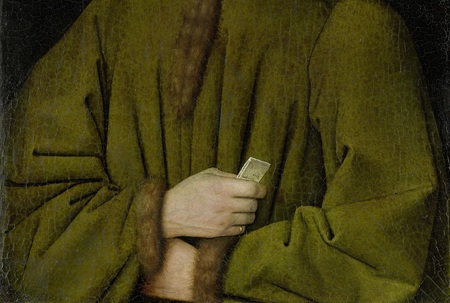
Portrait of a Man in a Red Chaperon (c1435-1438)
by Jan van Eyeck, Gemäldegalerie
Along with his fancy headdress, the man wears a dark green, fur-trimmed garment. In one hand, he clasps a note, while the other is tucked into a sleeve. Again, van Eyck takes pains to include details, like the pale blue veins we see in the man’s hands, the wispy tendrils of fur, and the glint of a pinky ring.
Double Take: The man in the red chaperon may look familiar. He is believed to be Italian merchant, Giovanni Arnolfini, who is featured with his wife/fiancé in van Eyck’s, Arnolfini Portrait (1434). At this time, portraits were a luxury afforded only by the gentry and having more than one was usually reserved for the ruling elite.
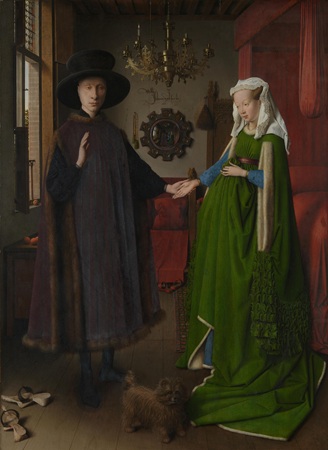
Arnolfini Portrait (1434) by Jan van Eyck
National Gallery London, Wikimedia
Courting: Arnolfini and van Eyck rubbed elbows in the Duke of Burgundy’s court where van Eyck served as a court painter and part-time diplomat. A prosperous merchant living in Bruges, Arnolfini provided the court with luxury items such as expensive textiles. The high-end goods displayed in Arnolfini’s portraits (e.g., rich fabrics, rugs, jewelry) are a testament to his wealth and status. They may have served as a 15th century version of LinkedIn or a résumé of sorts to advertise his success, and van Eyck was the premier painter to showcase Arnolfini’s achievements and business savvy in not just one, but two portraits.
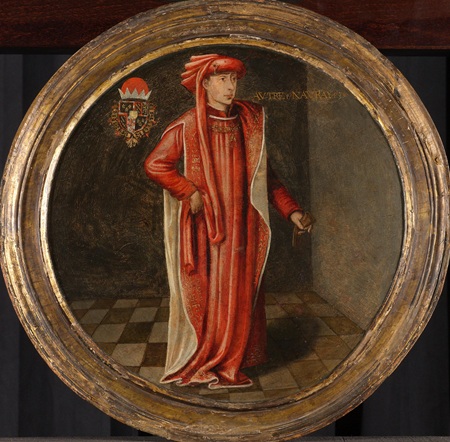
Portrait of Philip the Good, Duke of Burgundy (c1460-1480)
Artist unknown, Rijksmuseum
Essential Oils: Jan van Eyck (c1390-1441) was a master of oil painting and his skill with a paintbrush transformed the art world. In addition to his precision and attention to detail, van Eyck excelled at creating vivid, realistic textures and lighting. When you look at a van Eyck painting, note how metal shines and light glows. Colors are enhanced and textures appear more real as if you can reach out and feel the coarseness of the carpet and silkiness of the fabrics.
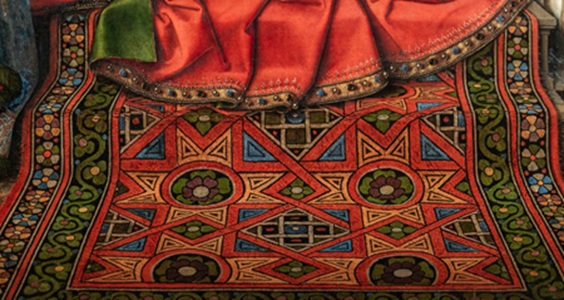
Closeup of Madonna with Canon Joris van der Paele (1436) by Jan van Eyck
Oil paint adds more luster because it produces a glossy sheen, whereas tempera paints favored by Italian artists at this time, produce a matte finish (think flatter, duller). Oil paint is thinner and dries more slowly than tempera so artists can play with it, make adjustments, and apply more layers. Brushstrokes can also be rendered imperceptible. The entire effect in van Eyck’s hands results in a lush, more true-to-life painting. See the comparison in the images below.
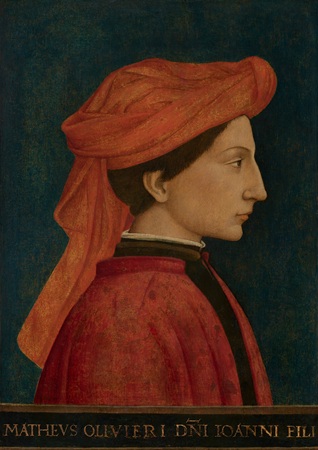
Left: Oil on wood Portrait of a Man in a Red Chaperon (c1435-1438) by Jan van Eyeck, Gemäldegalerie
Right: Tempera on panel Portrait Matteo Olivieri (1430s) by unknown Florentine artist, National Gallery of Art
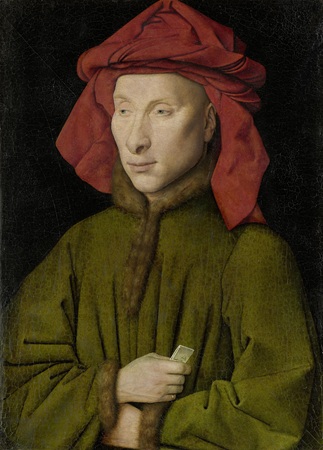
Calling Card: Arnolfini’s portraits showcased the merchant’s success, but they also showed off van Eyck’s artistic skill. This is especially evident in Portrait of a Man (1433) which is presumed to be a self-portrait of van Eyck. Some art historians have suggested this painting could have been a key piece in his portfolio. Potential clients, like Arnolfini could compare the real-life van Eyck to the image he painted of himself to see the extent of his skill.
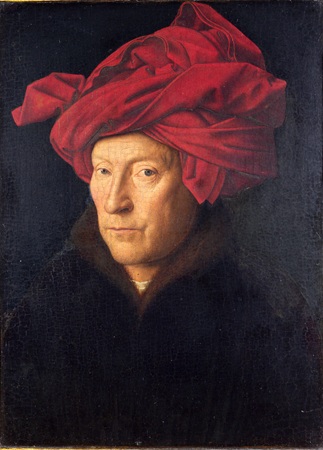
Portrait of A Man (1433) by Jan van Eyck, National Gallery London, Wikimedia
Where is the Man in the Red Chaperon? The red chaperon was a signature look in van Eyck paintings. He featured them more blatantly in his self-portrait and Portrait of a Man in the Red Chaperon, but also more subtly such as in the background or reflected in shiny objects like a mirror or metal shield. It is unclear if these Where-is-Waldo-like images are mini self-portraits or just a clever easter egg for viewers. Regardless, they are a delightful van Eyck quirk.
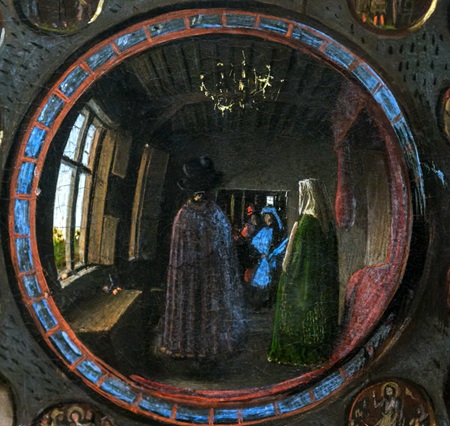
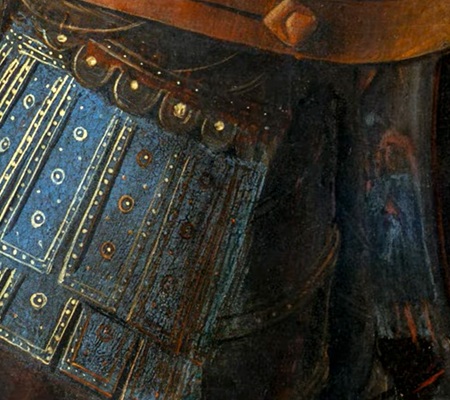
Left: Arnolfini Portrait (closeup of man in red chaperon;1434) by Jan van Eyck, National Gallery London
Right: Madonna with Canon Joris van der Paele (closeup of man in red chaperon;1436) by Jan van Eyck
If you’d like to see more of van Eyck’s work and play Where is the Man in the Red Chaperon (a game I just made up), click on this Google Arts & Culture: Jan van Eyck link. Note only a small number of his paintings include a red chaperon. Consider it part of the challenge.
But wait, there’s more! The entire collection of Jan van Eyck’s portraits will be on display for the first time at the National Gallery in London from November 21, 2026 to April 11, 2027. Click on this National Gallery of London Events: Van Eyck Portraits link to learn more. If you have the means, go check it out!
Arty Facts:
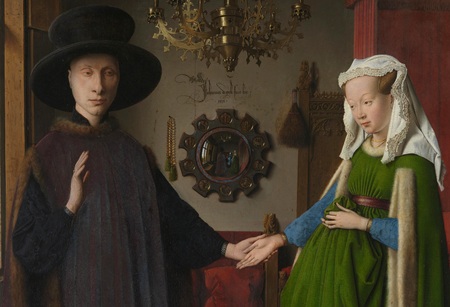
- Giovanni Arnolfini was eventually knighted and appointed governor of finance for King Louis XI of France.
- Van Eyck added his unique signature to several of his paintings, which was unusual for the time.
- The woman in the Arnolfini Portrait is not pregnant (a common misconception). She has gathered up and is holding the fabric of her dress near her stomach.
That wraps up our look at Portrait of a Man in a Red Chaperon. I’ll be back next week with more Museum Bites. Until then, be safe, be kind, and take care😊
Sources:
Art History 14th to 17 Century Art (2014) by M Stokstad, Marilyn & MW Cothren
Encyclopedia Britannica: Jan van Eyck
Encyclopedia Britannica: Philip III, Duke of Burgundy
Google Arts & Culture: Jan van Eyck
Metropolitan Museum of Art: Jan van Eyck
National Gallery of Art: Portrait of Matteo Olivieri (?)
National Gallery of London: Arnolfini Portrait (1434)
National Gallery of London Events: Van Eyck Portraits
National Gallery of London: Jan van Eyck
SmartHistory: Jan van Eyck, The Arnolfini Portrait
Staatliche Museen zu Berlin Gemaeldegalerie: Portrait of a Man in a Red Chaperon (c1435-1438)
 Museum Bites