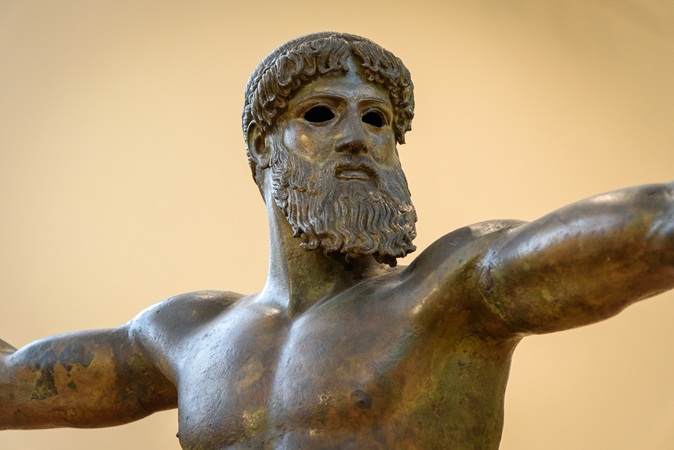
Today on Museum Bites we’re paying tribute to the God of Cape Artemision (c460 BCE), an ancient Greek statue with a colorful past. Built during the Greco-Persian Wars, this magnificent work of art escaped the melting pot, survived a Roman shipwreck, and spent more than a thousand years beneath the Aegean Sea. Join me for a closer look at this gorgeous statue. First, let’s dive into the details…
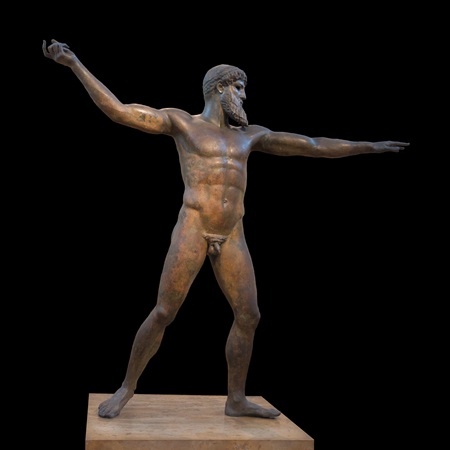
Artemision Bronze (c460 BCE), Hellenic National Archaeological Museum
Photo by Jebulon, Wikimedia
Standing just over 6 feet 10 inches tall, the Artemision Bronze was created using the lost-wax technique. Note his somber expression and curly, well-manicured hair and beard. A braided circlet of hair surrounds his head like a crown and keeps his wavy bangs in check. His empty sockets once contained eyes made of glass.
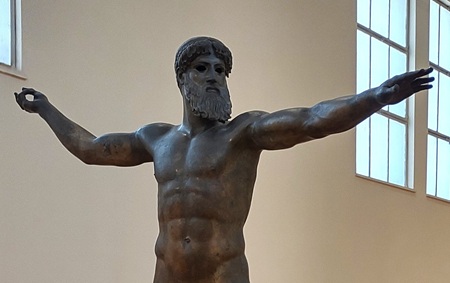
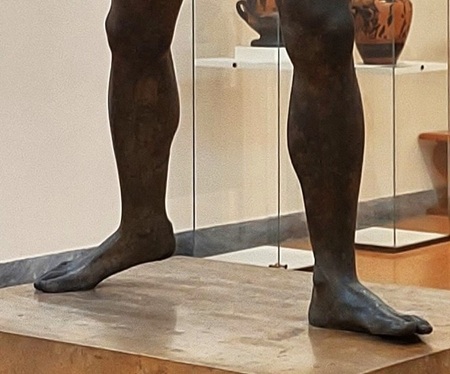
Artemision Bronze (c460 BCE) Hellenic National Archaeological Museum, Photos by cjverb (2024)
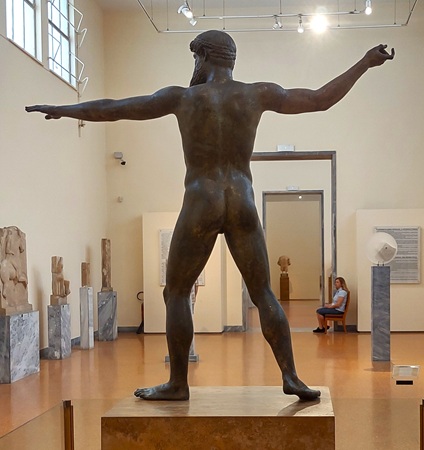
As we zoom out, take note of his outstretched limbs. His right hand lightly grasps a missing tool or weapon while the left arm provides balance and a sightline for his target. Balancing on his left heel and the ball of his right foot, he is poised to launch his missile.
Nimble and Fluid: The Artemision Bronze is an excellent example of the Severe style (aka Early Classical; c500–450 BCE) of ancient Greek sculpture. It features a more fluid, balanced, and lifelike representation of the human body, as opposed to the previous Archaic style (c650 to 480 BCE) which is characterized by a stiff, less natural pose, tight-to-the body limbs, and the charming archaic smile .
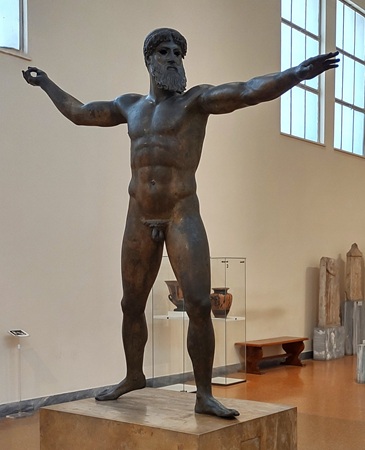
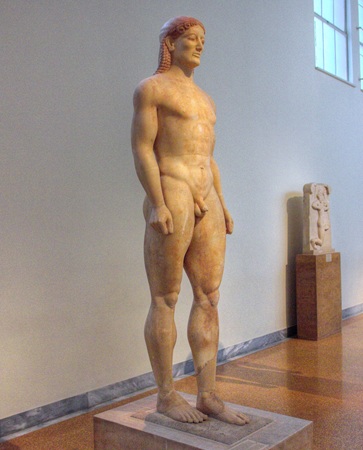
Left: Artemision Bronze (c460 BCE; Severe Style) Hellenic National Archaeological Museum, Photo by cjverb (2024)
Right: Anavyssos Kouros (c530 BCE; Archaic Style) Hellenic National Archaeological Museum, Photo by Sailko, Wikimedia
Godly Glow: At one time, the Artemision Bronze’s hair, eyebrows, and beard were inlaid with silver and his bronzed body gleamed. Big, buffed, and brilliant he was built to dazzle. No mere human, the Artemesion Bronze represents a god. Which god, however, has been up for debate.
Sibling Rivalry: Since his full recovery from the seabed in 1928, researchers have debated whether the Artemision Bronze is a representation of Zeus or his brother, Poseidon. After pouring over ancient Greek images of the siblings on coins, pottery, and statues the majority favor Zeus. They point out the Artemision Bronze’s stance is similar to Archaic era figurines of Zeus hurling a thunderbolt. Also, the wider grasp of the object in the Artemision Bronze’s right hand suggests a thunderbolt, as opposed to the much narrower and longer shaft of a trident.
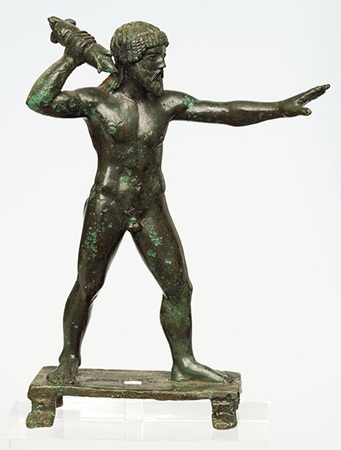
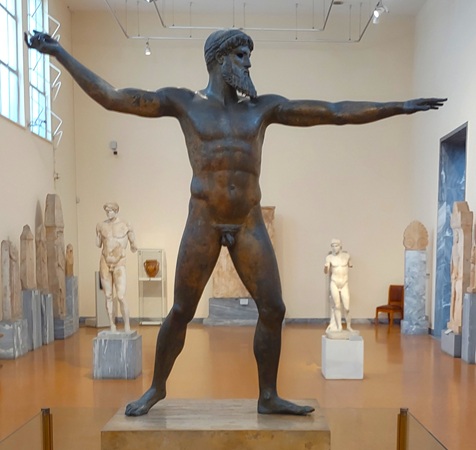
Left: Bronze figurine of Zeus Ceraunaeus hurling a lightning bolt (470-460 BCE) Hellenic National Archaeological Museum
Right: Artemision Bronze (c460 BCE), Hellenic National Archaeological Museum, Photo by cjverb (2024)
Furthermore, if the Artemision Bronze were holding a trident, it would block our view of the god’s face. Note in the tetradrachm pictured above, how we can see one side of Poseidon’s face, because his head is turned in full profile. Notice how the Artemision Bronze’s head is turned slightly forward. If he were holding a trident, it would obstruct our view of his face. Given the sculptor’s attention to detail (i.e., silver inlay, braided circlet, glass eyes), Poseidon wielding a trident that would interfere with the bronze’s meticulously handcrafted face seems unlikely.
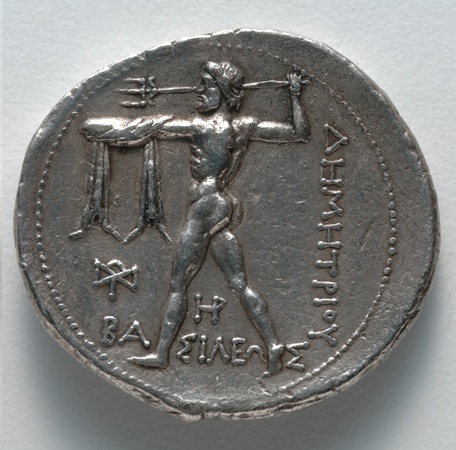
Left: Tetradrachm with Poseidon (c300–295 BCE), Cleveland Museum of Art
Right: Artemision Bronze (c460 BCE) Hellenic National Archaeological Museum, Photo by cjverb (2024)
Saved by a Shipwreck: The Artemision Bronze and bronzes from this time period are rare because they were melted down and repurposed by subsequent generations. Early Christians, in particular, considered these homages to the gods, pagan idols. The Artemision Bronze was “saved” when he was transported on a Roman ship that wrecked near Cape Artemision, located off the northern coast of Euboea, Greece’s second largest island. The bronze tumbled to the seafloor and remained covered in barnacles and sea creatures for more than 1,000 years. In 1926, his left arm was fished out of the water. Named for a nearby ancient sanctuary dedicated to Artemis Proseioas, a full recovery of the Artemision Bronze did not take place until October 1928.
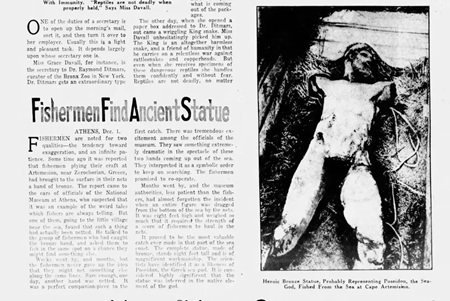
Discovery of the Artemision Bronze (c460 BCE) featured in
The San Francisco Examiner, Dec. 23, 1928
Today the Artemision Bronze stands fully restored, sans his glassy eyes, in the Hellenic National Archaeological Museum in Athens. If you’re ever in the neighborhood, I highly encourage you to pay him a visit and bask in his godly glow. You can also compare him to the less fluid, but smiling, kouroi from the Archaic Period just a few rooms away. In the meantime, you can tour the museum from the comfort of your home by clicking on this Hellenic National Archaeological Museum of Athens Virtual Tour link. But wait there’s more, if you have access to a virtual reality headset the museum also offers a 3D tour. And while you’re at it why not check out this short but fascinating video demonstrating the lost-wax technique by clicking on this Capturing an Emperor’s Face in Bronze link courtesy of National Geographic. Enjoy!
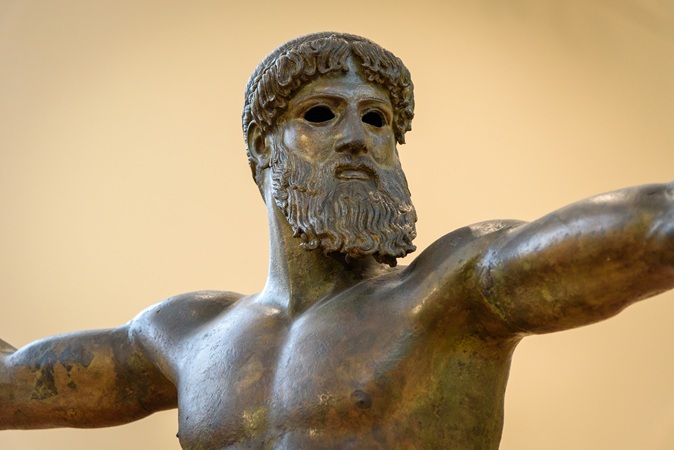
Artemision Bronze (c460 BCE), Hellenic National Archaeological Museum,
Photo by Mustang Joe, Wikimedia
Arty Facts:
* Cape Artemision was also the site of the Greco-Persian Battle of Artemisium (480 BCE). After 3 days of fighting, the Persians declared victory after the Greeks retreated upon learning of their defeat at Thermopylae.
* The Artemision Jockey (c140 BCE) a bronze statue of a young boy riding a horse, was also recovered off the Cape of Artemision.
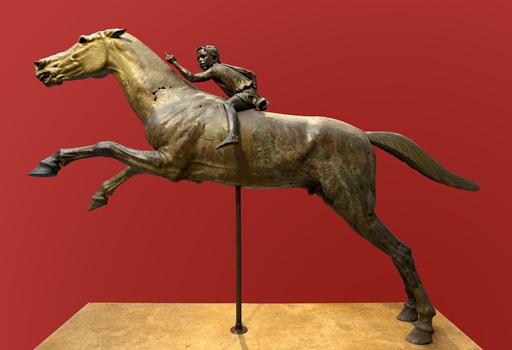
Jockey of Artemision (c140 BCE)
Hellenic National Archaeological Museum,
Photo by Niko Kitsakis, Wikimedia
That concludes our look at the Artemision Bronze. I’ll be back next week with more Museum Bites. Until then, be safe, be kind, and take care😊
Sources:
American Journal of Archaeology, The Bronze Statue from Artemision (1944) by George E. Mylonas
Encyclopedia Britannica: Battle of Artemisium
Encyclopedia Britannica: Euboea
Encylcopedia Britannica: Greco-Persian Wars
Encyclopedia Britannica: Western Sculpture-Ancient Greek
From the Archivist’s Notebook: The Artemision Shipwreck: Sinking Into the ASCSA Archives
Hellenic National Archaeological Museum
Hellenic National Archaeological Museum: Classical Period
Hellenic Archaeological Museum of Athens Virtual Tour
National Geographic: Capturing an Emperor’s Face in Bronze
Odysseus: Greece’s Ministry of Sport & Culture
SmartHistory: Artemision Zeus or Poseidon
The Art and Archaeology of Ancient Greece (2014) by Judith M. Barringer
TheArtStory: Classical Greek & Roman Art
The Journal of Hellenic Studies, The find from the Sea off Artemision (1929) by Chr. Karouzos
 Museum Bites