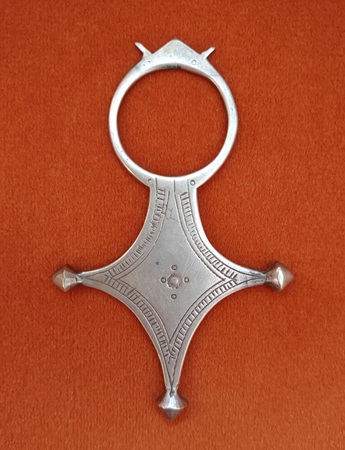
Happy Friday! Today on Museum Bites we’re traveling to the Sahara to take a closer look at the Cross of Agadez. These simple, elegant pendants were created by the Tuareg (pronounced TWAH-regg) more than a century ago. Join me to learn how this unique piece of jewelry transformed from a private ceremonial object to a symbol of cultural identity.
Cast in silver and handcrafted by Tuareg smiths, each Cross of Agadez is custom-made using the lost-wax process, a technique that dates back to the Bronze Age (see Arty Facts below to learn more). Let’s zoom in on the details.
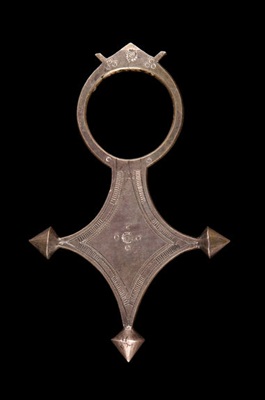
Cross of Agadez (before 1902) Tuareg peoples, Niger, Museé du Quai Branly Jacques Chirac
The upper half is comprised of a loop with lobes or ears jutting from the top, while the lower half is diamond-shaped (i.e., a lozenge) with pointed tips. Geometric designs are typically etched into the surface. Note in this example, the etchings along the border, and circles at the center of the lozenge and top of the loop. Since the Cross of Agadez is custom-made, no two are identical. Smiths make variations to the ears, geometric designs, and the shape of the tips, but the form (lozenge and loop) has remained the same for over 100 years.
Background: The Tuareg live predominantly in northwestern Africa and their traditional homeland is called Azawad. Agadez, their capital city, was established by the Tuareg in the 15th century and today is located in modern-day Niger. Traditionally, they were semi-nomadic and played a key role in trans-Saharan trade by organizing and managing camel caravans.
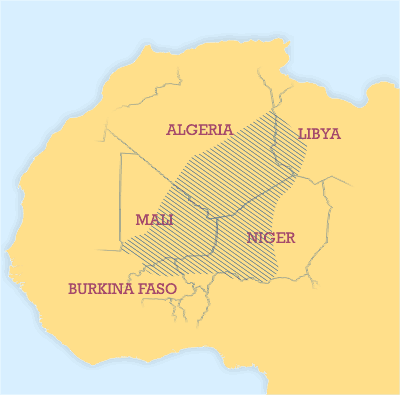
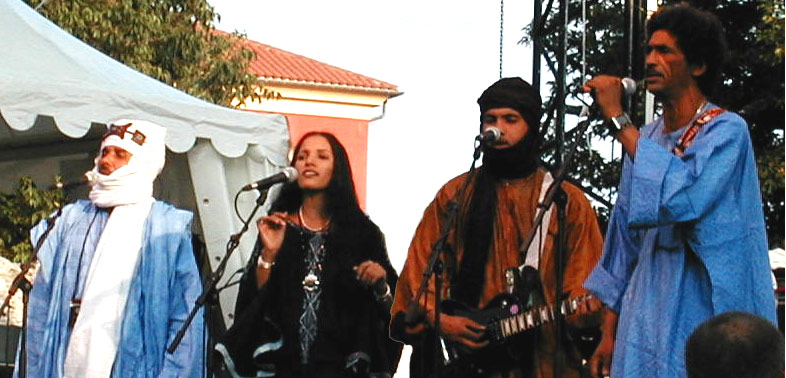
Left: Map of Azawad by Mark Dingemanse; Right: Tuareg Musical Group Tinariwen (2005), Photo by Andrew Levine, Wikimedia Commons
A Visual Language: Jewelry plays a key role in Tuareg society. From infants to grandparents, all Tuareg wear jewelry every day. It provides protection against evil and disease, is gifted to celebrate major life events (e.g., adulthood, marriage, birth of children), and is a form of portable wealth that is passed down through families. Although there are regional variations, Tuareg societal norms specify who, what, when, where and how much jewelry can be worn.
According to art historian, Kristyne Loughran, in Tuareg society, jewelry is a “visual language”. It serves as a symbol of Tuareg identity, because the type of jewelry worn indicates a person’s gender, life-stage, social standing, and where they come from. For example, at age 7, young girls begin wearing their first metal jewelry, the chatchat, a beaded necklace with small triangular pendants that represent little dolls.
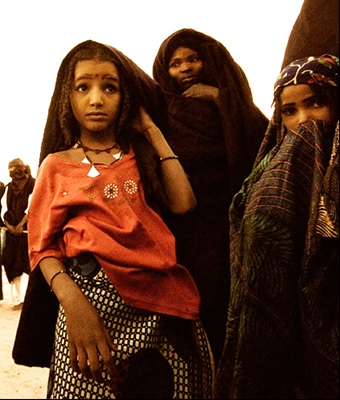
Tuareg Girl Wearing the Chatchat (2007) Photo by S. Wojtkowiak, Flickr
From Private to Public: The Cross of Agadez was initially a ceremonial gift given by Tuareg noblemen to their sons upon their initiation into adulthood. It was considered amuletic (protective) and worn beneath their clothing.
Son, I give you the four directions of the world because we do not know where you will die.
Recitation by noble Tuareg fathers at sons’ initiation (Dieterlen & Ligers, 1972)
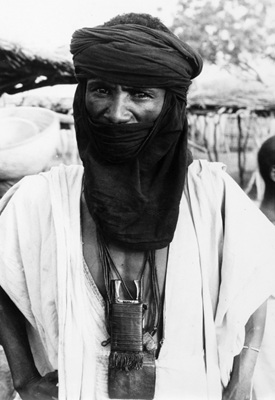
Tuareg Man Wearing Amulets (early 20thc), Tropenmuseum, Photo by J. Broekhuijse
In the latter half of the 20th century, the Cross of Agadez was worn publicly and almost exclusively by Tuareg women, regardless of their social class. Colonial rule had come to an end and the Tuareg were left disenfranchised and their homeland remained out of their control. Thus, the Cross of Agadez transformed from a private, ceremonial object to a public symbol of Tuareg identity.
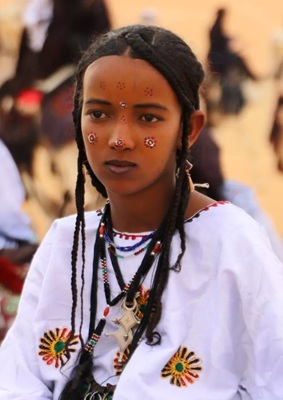
Young Tuareg Woman Wearing the Cross of Agadez, Niger (2022), Wikimedia Commons
Today, the Cross of Agadez can be found on postage stamps and currency in Niger, motifs in haute couture, and replicas are sold in markets or on Etsy for the tourist trade. In Tuareg communities, smiths continue to handcraft the Cross of Agadez, and its image can be found painted on homes and displayed in shop windows. It is still considered amuletic and remains a symbol of Tuareg identity and culture. According to anthropologist, Susan Rasmussen, the Cross of Agadez is a visual reminder to the Tuareg people of their traditional nomadic life and their homeland, Azawad. If you’d like to learn more about the Tuareg click on this Tuareg link courtesy of UNESCO.
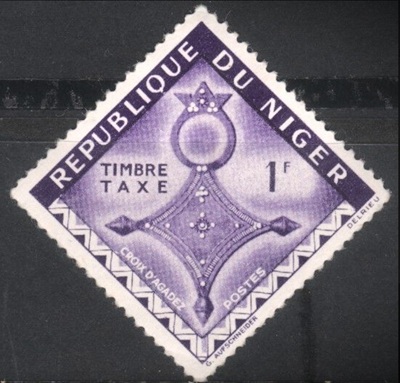
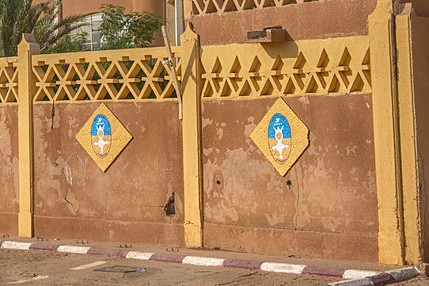
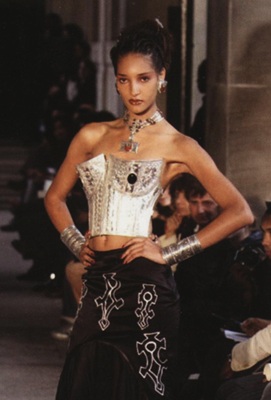
Top Left: Niger Stamps with Cross of Agadez, Photo by lesbubstuff, Ebid
Bottom Left: Palace Fence with Cross of Agadez Motif, Air Mountains Niger, Wikimedia Commons
Right: Skirt with Cross of Agadez Motif, Alphadi Haute Couture (2004-2005), Gilvin (2014)
Arty Facts:
* The Cross of Agadez is not a crucifix or associated with any religion.
* French colonists coined the term based on the pendant’s shape and Agadez origins.
* The lost-wax process is still used today. Click on this Cross of Agadez: Lost-Wax Process link and watch a short clip on how it’s made.
* The majority of Tuareg live in Agadez, Niger and Kidal, Mali. Some continue to fight for Azawad.
That concludes our look at the Cross of Agadez. I’ll be back next week with more Museum Bites. Until then be safe, be kind, and take care.
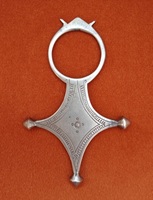
Cover image of the Cross of Agadez by cjverb (2026)
Sources:
African Arts: Hot and Haute: Alpha’i’s Fashion for Peace (2014) by Amanda Gilvin
African Arts: Jewelry, Fashion, and Identity: The Tuareg Example (2003) by Kristyne Loughran
Encyclopedia Britannica: Lost-Wax Process
Museé du Quai Branly Jacques Chirac
Tuareg Jewelry: Continuity and Change (1996) by Kristyne Loughran
 Museum Bites